







|
Scientific Manager: Javier Marugan Aguado Technical support: Javier Marugan Aguado Address: Departmental I. c/ Tulipán s/n. Mostoles 28933 Department: Department of Chemical and Environmental Technology Phone: 916 647 466 Fax: 914 887 068 Website: https://www.lagua-urjc.es |
|
Essays/Services offered
Types of techniques used
- Electrometry and potentiometry: pH, conductivity, chloride selective electrode (ISE).
- nephelometry (860 nm): ISO 7027 online turbidity.
- UV-Vis Spectrophotometry: color, COD (dichromate, sealed tubes) and colorimetries of nutrients (NH₄⁺, NO₂⁻, NO₃⁻, PO₄³⁻) with discrete analyzer.
- Gravimetry: suspended solids, dissolved solids, dry residue; loss on ignition for volatiles.
- Classical Microbiology: membrane filtration/plating with selective media (Chromocult, Slanetz), incubation and counting of total and fecal coliforms, E. colienterococci y aerobic/heterotrophic.
- Parasitology: count of intestinal nematode eggs (modified Bailenger method; see quality recognition).
Types of essays
Then a representative summary of the usual operational scope of LAGUA in wastewater and reclaimed water.
- Color, pH, conductivity, turbidity, dissolved oxygen. Equipment: UV-Vis, HI6000 multiparameter, TL2310 turbidimeter, HI9147N OD.
- Solid: suspended, volatile (muffle furnace), settleable (Imhoff cone), dissolved and dry residue (oven, scales).
- COD (dichromate, digestion in VELP ECO25 and UV-Vis reading).
- DBO5 (5-day incubation with Velp DBO System 10).
- Nutrients: Total N, Ammonium N, NO₂-, NO3-, P-reactive and P-total, through Seal AQ300 with prior digestion (BD28).
- Residual and total chlorine (DPD) with photometer HI96710C.
- Selected anions: chlorides by ISE (HI4107); sulfates, nitrates, nitrites by automated colorimetric analysis.
- Microbiology: total and fecal coliforms, E. colienterococci, cultivable aerobes and heterotrophs (filtration/sowing and incubation in selective media).
- Intestinal nematode eggs (modified Bailenger method).
Internal calibrations and verifications (examples): pH meters (traceable standards), conductivity meters, balances (F1/F2 weights), turbidimeter (formazin standards), photometer (verification with standards).
Samples analyzed
The laboratory specializes in sewage water y regenerated water, focusing on process control tests and/or regulatory compliance (with microbiological and physicochemical scope).
Upon request, specific sampling campaigns and designs for related matrices in the urban and industrial field are accepted (subject to prior technical assessment).
Procedures
Procedures or standards applied (sampling, reception, environmental conditions, handling)
Sampling and preservation
- Planning of points, bottles and preservatives by parameter/matrix; cold transport (≤ 6 °C) and recording of chain of custody.
- Microbiological sampling with sterile material and control of times until analysis (preferably ≤ 24 h).
- Preservation and subsampling in accordance with internal SOPs and standardized methodologies (ISO/EN/Standard Methods).
Sample reception
- Entry record: unique identifier, date/time of collection and receipt, type of preservation, matrix, requested parameters, responsible party.
- Criteria for acceptance/rejection: integrity of packaging, temperature upon receipt, volume, storage times and absence of cross-contamination.
Environmental conditions and area segregation
- Separate areas for physicochemical analysis (UV-Vis, COD/BOD, gravimetry, nutrients) and microbiology (Class II cabinet, sterilization, incubation), with cleaning controls and T/H records.
Handling and preparation
- Filtration (0,45 µm) when applicable (dissolved), thermal digestions (BD28/ECO25), preparation of calibration curves and independent verification per batch.
Quality Assurance and Quality Control (QA/QC)
- Inclusion of of Blancos (reagent/field), duplicates, fortified y reference materials when appropriate.
- Control charts and trend analysis; non-conformity management and corrective actions.
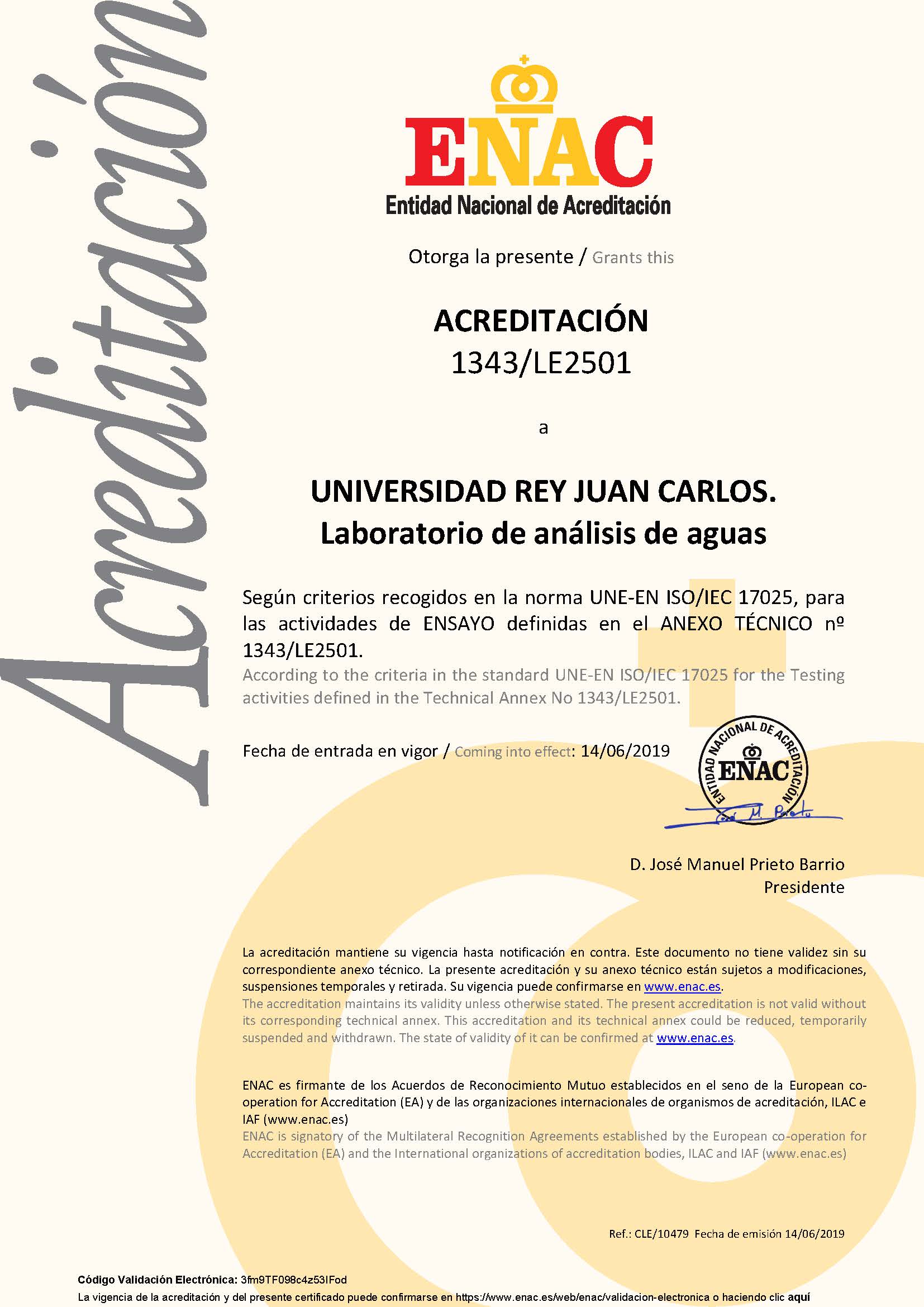
- History of UNE-EN ISO/IEC 17025:2017 accreditation (2019–2024) and procedures aligned with said standard.
Safety and waste management
- Chemical/biological risk assessments, PPE and training; segregation and delivery to authorized managerClass II cabin and autoclave for contaminated materials.
Technical reference standards (selection):
ISO 7027 (turbidity), ISO 10523 (pH), ISO 7888 (conductivity), ISO 5815 (BOD), ISO 15705/6060 (COD), EN 872 (suspended solids), colorimetric methods for nutrients (Standard Methods/APHA-AWWA-WEF), selective microbiological methods (ISO 9308-1, ISO 7899-2), and Bailenger method modified (nematodes).
Staff
Scientific personnel responsible for the scientific-technical service:
Javier Marugán Aguado, Laboratory Director, Technical Manager. Professor of Chemical Engineering with over 25 years of research experience in water treatment technologies. Proven expertise in water analysis techniques, both physicochemical and microbiological. Training in the implementation of quality systems in laboratories according to the UNE-EN-ISO 17025 standard.
Yolanda Segura Urraca, Quality ManagerProfessor of Chemical Engineering with over 20 years of research experience in water treatment technologies. Proven expertise in water analysis techniques. Training in the implementation of quality systems in laboratories and in quality audits according to the UNE-EN-ISO 17025 standard.
Isabel Pariente Castilla, Head of the Physicochemical Testing AreaProfessor of Chemical Engineering with over 20 years of research experience in water treatment technologies. Proven expertise in physicochemical techniques for water analysis. Training in the implementation of quality systems in laboratories according to the UNE-EN-ISO 17025 standard.
Cristina Pablos Carro, Head of the Microbiological Testing AreaFull Professor of Chemical Engineering with over 15 years of research experience in water treatment technologies. Proven expertise in microbiological water analysis techniques. Training in the implementation of quality systems in laboratories according to the UNE-EN-ISO 17025 standard.
Technical staff dedicated exclusively to scientific and technical service:
Cristina Ramírez Miguel, Laboratory technicianGraduated in Environmental Sciences in 2018 with over 5 years of laboratory experience in water analysis techniques. Employed full-time with a permanent contract, dedicated exclusively to LAGUA.

Available equipment
Instrumental measurement and preparation
- UV-Vis Spectrophotometer LLG Labware uniSPEC 2 (color, COD and nutrient colorimetry).
- Modular multiparameter system Hannah Instruments HI6000 with probes:
• pH HI1131B · Conductivity HI7631233 · Chlorides ISE HI4107. - Turbidimeter hash TL2310 edition 5 (ISO 7027).
- Dissolved oxygenHanna Instruments meter HI9147N.
- COD: thermoreactor VELP ECO25 + UV-Vis reading; use in Köttermann 2‑453 fume cupboard DAHD.
- DBO5: system Velp DBO System 10 + Thermo Scientific Heratherm IMP180 refrigerated oven.
- Nutrients (automated colorimetric analysis): Seal Analytical AQ300; digester Seal Analytical BD28 Block for N-total/P-total (work in Köttermann display case).
- Residual and total chlorine: Hanna multiparameter photometer HI96710C (DPD).
Gravimetry, solids and temperature
- Balances: KERN ABT 220-SDNM and KERN PCB-2000-1.
- Greenhouses and shadehouses: Binder FD115 (drying) and Thermo Scientific Heratherm IMP180 (incubation).
- muffle Thermolyne F30420C-33 (volatile solids).
- Imhoff cone 1 L Kartell (settleable solids).
Microbiology
- Class II biosafety cabinet TELSTAR BIO-II ADVANCE 6.
- Autoclave Selecta Presoclave III Plus.
- Fridge Candy CVBN 6184WBF (preservation of media/samples).
- Binder FD115 Stove (incubation, counts).
Comment: The scope of service additionally includes determinations of intestinal nematode eggs and other microbiological counts.