


- Access and registration
- documentary commitment
- Research Ethics
- Industrial Mention
- Thesis Supervision and Monitoring (RAPI)
- Thesis submission and defense
- Duration of studies
- Awards and monograph collection
- Grants for doctoral theses
- Tenders
- Thesis Project Offer
- Student procedures
- PDI procedures
- EID Calendar
- IA Commission
- Good Practice Guide
Access and registration
Admission process
🔹 1. 🔍 See program offerings Review the available doctoral programs and verify that you meet the access and admission requirements.
🔹 2. 📝Present your application for admission Complete the application for admission within the established deadline and attach the required documentation.
🔹 3. 🔍Check the status of your applicationThrough the pre-registration platform you can check the status of your application and, if necessary, correct it.
🔹 4. 👥 Candidate evaluation The program's Academic Committee will analyze your academic record, research profile, and submitted documentation.
🔹 5. ✅ Result of admission to doctoral studies. You will receive notification that you have been assigned a place in the doctoral program through the pre-registration application.
🔹 6. ???? Formalize your registration If you have been admitted, you must register within the established deadlines to acquire the status of doctoral student.
🔹 7.🎓 Enrollment in the program Once enrolled, you will be assigned a tutor/thesis director, and you will begin your research activity.
Admission requirements
To access the Doctorate, it is necessary to prove compliance with the general access requirements and pass a competitive admission process according to the criteria set by the Academic Committee of each Doctoral Program.
General requirements for access to the Doctorate
Link to the general requirements for access to the Doctorate
🎓 Types of access to doctoral studies in Spain (RD 576/2023) + documentation
|
Access route |
Requirements |
📄 Documentation to be submitted |
|
✅ Regular access (Bachelor's + Master's) |
300 ECTS (min. 60 master's degree) |
- Bachelor's Degree |
|
✅ University Degrees ≥ 300 ECTS |
Accreditation of MECES level 3 Degrees of between 300 and 360 ECTS credits (Medicine, Architecture…) and Procedure established in the Royal Decree 967/2014, of November 21 |
- Bachelor's Degree |
|
✅ Foreign qualification |
Master's level equivalent (MECES level 7) |
- Foreign university degree |
|
✅ Specialized healthcare training |
MIR, FIR, EIR, etc. |
- Specialist title |
|
✅ Previous systems (AED) |
DEA or research proficiency |
- DEA certificate or research proficiency |
Requirements specific to Branch of knowledge/Doctoral Program
Access each branch of knowledge to consult the specific requirements of each doctoral program:
DOCTORAL PROGRAMS IN EXTINCTION
Doctoral Program in Social and Legal Sciences (in the process of extinction)
Doctoral Program in Multimedia and Communications (Interuniversity) (in the process of extinction).
Doctoral Program in Tourism (interuniversity) (4 Universities) (in the process of extinction).
International students
How is a residence permit for national research processed?
-
Gain admission to a doctoral program at URJC.
-
Submit the application for a residence permit for national research to the Large Companies and Strategic Groups Unit (UGE-CE)The application can be submitted by the interested party.
-
Provide the documentation required by immigration regulations, including, among others, the documentation proving admission to the doctoral program and the documents that may be required in each case.(Specific documentation must be verified on the electronic portal and in the instructions of the UGE-CE).
-
Wait for the authorization decision.
-
If the person is outside of SpainOnce the authorization has been granted, you must apply for the corresponding visa at the competent Spanish Consulate.
-
After his arrival in SpainYou must complete the identification and documentation procedures established by immigration regulations.
The national research residence permit is submitted exclusively electronically, so it is necessary to have an electronic certificate.
To obtain an electronic certificate, it is usually necessary to have a Foreigner Identity Number (NIE)The assignment of a NIE does not, in itself, imply the granting of a residence or stay authorization in Spain, but it allows identification in relations with Spanish public administrations.
Some Spanish consulates allow you to apply for a Foreigner Identification Number (NIE) and obtain an electronic certificate when you need to carry out procedures with the Spanish Administration, such as applying for a residence permit for national research related to doctoral studies. It is recommended that you consult the specific requirements and procedures with the relevant Spanish consulate in your country.
Important: If you obtain a NIE (Foreigner Identification Number) beforehand, you must use the same number in the subsequent application for the national research residence permit.
Admission request
Outline of the admission process
Admission process to Doctoral Programs
| Phase | What happen? | Application Status |
|---|---|---|
| 1. Submission of the application | The applicant completes the self-registration, selects the doctoral program, and attaches the required documentation within the established deadline. | Documentation pending or pending (when all the required documentation is uploaded in the corresponding sections) |
| 2. Document review | The International Doctoral School verifies that all required documentation has been submitted. If any documentation is missing, it will be requested that it be provided. | Documentation pending o Pending |
| 3. Provisional results of pre-registrations admitted for study and excluded | The provisional status of applications accepted for review and those rejected can be checked in the pre-registration application. Applications with incomplete documentation will receive instructions on how to correct the deficiencies by clicking on the icon that appears above the application status. | Documentation pending (needs correction) o Pending (correct documentation) |
| 4. Correction of documentation | Applicants whose applications have been excluded from review due to lack of documentation may submit the required documentation during the established correction period through the pre-registration application. | Documentation pending or pending (when all the required documentation is uploaded to the corresponding sections) |
| 5. Final results of pre-registrations admitted for study and excluded | Once the correction period has ended, the final status of applications accepted for review and those rejected can be viewed in the application. Only applications accepted for review continue in the academic evaluation process. | Pending or excluded |
| 6. Verification of admission requirements and academic evaluation | The Program's Academic Committee reviews the application to ensure it meets the access requirements and evaluates applications according to the published admission criteria. | Validated |
| 7. Result of admission to the program | Once the evaluation is complete, the available places are allocated. | Validated. Granted o Validated. Waiting list |
| 8. Communication of the result | Applicants can check the final admission result through the pre-registration application. Applicants may submit an appeal if they disagree with the result. | final state |
| 9. Tuition | Admitted candidates formalize their registration within the established deadlines to confirm the place obtained. | Place confirmed |
Note: The resolutions of the procedure are consulted exclusively through the pre-registration application and not through publication on the website
Calendar and places offered
| Doctoral Program | Plazas | |
|---|---|---|
| 🧪 | Science | 30 |
| (I.e. | Health Sciences | 60 |
| (I.e. | communication Sciences | 20 |
| 💼 | Economics and Business Sciences | 45 |
| 🎓 | Educational Sciences and Sports Sciences | 15 |
| ️ | Legal and Political Sciences | 40 |
| ???? | Humanities: Language and Culture | 30 |
| 💧 | Hydrology and Water Resources Management (Interuniversity) | 10 |
| ✈️ | Tourism (Interuniversity) | 15 |
| ???? | Conservation of Natural Resources | 10 |
| 💻 | Information technology and communications | 50 |
| ⚙️ | Industrial, Chemical, Environmental, Energy, Electronics, Mechanical and Materials Technologies | 40 |
| ♀️ | Interdisciplinary Gender Studies (Interuniversity) | 5 |
| 📈 | Epidemiology and Public Health | 10 |
📢 Academic Calendar Pre-registration: see here
Documents to be submitted
- Mandatory Documentation to be presented,
- presentation letter y
- Declaration of veracity of the data provided
- Declaration of delivery of foreign degrees pending legalization
- Researcher endorsement letter as possible thesis director (Complete this form)
- Letter of support from a researcher as a prospective PHD supervisor (Form)
✅ 1. General mandatory documentation
All applicants must submit:
- 🎓 Bachelor's and Master's Degrees (or receipt for title application)
- 📊 Official academic certification (grades and credits)
- (I.e. Identity document (DNI/NIE or passport)
- 📄 Curriculum vitae (CV)
- (I.e. Signed cover letter
- ✅ Responsible declaration of veracity
- 📄 Declaration of delivery of documentation pending legalization (if applicable), which can be consulted and downloaded in the pre-registration application itself..
🌍 2. Documentation for studies in the EHEA
If you have studied within the European Higher Education Area (EHEA)You must contribute:
- 🎓 University degree (Bachelor's and Master's)
- 📊 Official academic certification
- 📄 European Diploma Supplement (SET)
- (I.e. Identity document (DNI/NIE or passport)
- 📄 Curriculum vitae (CV)
- (I.e. Signed cover letter
- ✅ Responsible declaration of veracity
🌍 3. Documentation for studies abroad (outside the EHEA)
If your degree is from a foreign country not belonging to the EHEA, you must provide:
- 🎓 Legalized/apostilled university degrees
- 📊 Complete legalized official academic certification
- 🌐 Document proving access to doctoral studies in the country of origin
- 🈯 Official translation into Spanish (if applicable)
- (I.e. Passport or residence card
- 📄 Curriculum vitae (CV)
- (I.e. Signed cover letter
- ✅ Responsible declaration of veracity
👉 Important: access does not imply validation of the degree in Spain.
📌 4. Additional documentation (according to program)
Some programs may require:
- 👨🏫 Letter of support from a potential thesis supervisor
- 🌍 Language certificate
- 📄 Specific or expanded CV
- Other program-specific requirements
📂 5. Specific cases
🎓 Master's degree not completed
You can apply for admission if:
- You provide the receipt for the title application within the correction period
📑 Documentation in process
If you have pending documents (legalization, SET, etc.):
- You can provide proof of application
- You must attach a sworn statement of commitment to delivery
⚠️ 6. Important Rules
- 📌 You must upload all documentation within the deadline
- 📌 Files must be readable and in a permitted format
- 📌 The total size cannot exceed the limit set in the application
- ❗ If required documentation is missing, your application will not be evaluated.
Claims
- Procedure for objections against non-admission to doctoral programmes at the International Doctoral School:
They may file a complaint:
- Applicants not admitted by the program's academic committee
- That they have been placed on a waiting list
- That they consider their assessment is not correct.
Following the academic calendar published by the International Doctoral School (EID) and once the pre-registration requests have been evaluated by each Academic Committee, the applicant will be informed of his or her admission or non-admission to the doctoral program through the application. If the applicant is admitted, he or she must enroll following the enrollment procedure published on the International Doctoral School website (link). If the applicant is not admitted, he or she may appeal in the first instance to the EID Steering Committee.
Claims will be submitted through the electronic headquarters' catalog of procedures, by means of a general application, addressed to the EID (link).
IMPORTANT: Objections against non-admission will not be accepted for:
-
Pre-registrations submitted after the deadline.
-
Apply for a doctoral program different from the one included in the pre-registration application.
- To submit new documentation
Students should be aware that during the registration and claims process, students' position on the waiting list may vary.
Pre-registration application
- Admission Application Guide: (Enlace)
- Admission Application Application https://gestion3.urjc.es/gestionsolicitudes/
Admission deadlines
| MES | DATE | ADMISSION PROCESS |
| JULY | Miércoles 1 | 🟢 Pre-registration period begins |
| SEPTEMBER | Friday 4 | 🔴 Pre-registration period ends |
| SEPTEMBER | Moons 14 | 📄 Results of applications accepted for review, applications that need to be corrected and those excluded |
| SEPTEMBER | Moons 14 | 📝 Start of documentation correction |
| SEPTEMBER | Friday 18 | 🔧 End of documentation correction |
| OCTOBER | Friday 9 | 📄 Final results of those admitted to study and those excluded |
| OCTOBER | Friday 9 | 📄 PhD admission results |
| OCTOBER | Friday 9 | 📢 Start of the period for objections |
| OCTOBER | Thursday 15 | 🔴 End of the period for objections |
| NOVEMBER | Wednesday 4th to Friday 6th | 📄 Resolution of allegations |
| FEBRUARY | Wednesday 24 | ✍️ Deadline for signing the Documentary Commitment |
-
The statuses of the pre-registration application They should be consulted in the pre-registration application.Its meaning is detailed in the section "Admission scheme".
Enrollment
📅 Registration deadlines and important dates for the 2026-2027 academic year
check here
The registration periods established for the different profiles of doctoral students are detailed below:
🔁 Second-year students or later
First installment: of July 27-31, 2026 (especially for second-year students and above who want to defend or submit their doctoral thesis)
Second installment: of 9 of the septiembre 21 of 2026
🆕 New students
Ordinary term: from October 9 to November 13, 2026
Extraordinary term (after resolution of allegations): from November 4 to 13, 2026
- Registration Guide: (Download)
- Guest account access guide (Spanish) / (English)
- Registration Application: https://automatricula.urjc.es/
Online Open House Days
VI Online Open Day of the International Doctoral School (May 19, 2026)
7th Online Open Day of the International Doctoral School (April 2025, XNUMX)
IV Online Open Day of the International Doctoral School (April 18, 2024)
III Online Open Day of the International Doctoral School (May 8, 2023)
II Online Open Day of the International Doctoral School (May 11, 2022)
I Online Open Day of the International Doctoral School (June 24, 2021)
Public Prices
DECREE 43/2022, of June 29, of the Governing Council, which establishes the public prices for university studies leading to official degrees and services of an academic nature in the public universities of the Community of Madrid.
| PUBLIC DOCTORATE PRICES | |
| CONCEPT | PRICE |
| Full-Time Academic Tutoring | 390 € |
| Part-time Academic Tutoring | 234 € |
| Thesis Reading | 143,15 € |
| Doctor's Degree Application | 229,83 € |
| School Insurance < 28 years | €1,12 |
| Secretariat expenses | €6,11 |
| Opening of the File | €27,54 |
|
* Training Complements: will be the price of the subject that corresponds to enroll (e.g. If it is a Master's degree, consult https://www.urjc.es/estudiar-en-la-urjc/precios-publicos#precios-publicos-y-formas-de-pago-de-estudios-de-master-universitario) **When registering for your Doctorate, the prices approved in the Decree will be applied. valid of the Governing Council of the Community of Madrid, which establishes the public prices for university studies leading to official titles and services of an academic nature in the public universities of this Autonomous Community. If these prices are subsequently modified by the approval of a new Decree that affects the enrolled course, the university will proceed to make the appropriate adjustments in the prices applied and notify the student body of this circumstance. ** |
|
Payment Methods
Single Payment:
Payment in a single installment through the following means to be selected in the self-registration:
- payment via Bank receipt, during the 10 days following the self-registration, through Banco Santander CaixaBank at: ATMs, digital banking, or at the counter.
- payment via Bank, credit or debit card,through the payment gateway (virtual POS) that will be enabled at the end of the self-registration process.
- payment via Bizum, through the gateway that will be enabled at the end of the self-registration process.
- International students: International students: Bank transfer, card and online with our partner for international payments, Flywire, which will be enabled upon completion of the self-enrollment process. Payment options can include bank transfers, credit cards, e-wallets, and more, from your home country and in your local currency. Flywire offers the best exchange rate at no additional cost.
Important!: Payment by credit card, payment for international students, Flywire, and payment via Bizum, will only be enabled after the completion of the self-registration process; if you abandon the process, you will only be able to resume payment by entering your Service Portal – Registration – Bill Payments
In non-EU countries with a currency other than the euro, through the payments available in each of the countries, and payments from the SEPA area (with euro currency) by bank transfer.
documentary commitment
documentary commitment
Once admitted to the Doctoral Program, the doctoral candidate must formalize the Commitment to Doctoral Thesis Supervision (DOCUMENTARY COMMITMENT).
This document will be signed by:
- The doctoral candidate.
- The academic tutor.
- The thesis director(s).
- The coordinator of the Doctoral Program.
- The Director of the International Doctoral School.
The agreement establishes the rights and duties of all parties involved in the supervision of the doctoral thesis and includes, among other aspects:
- The commitment to comply with code of good practice.
- Thesis monitoring and supervision mechanisms.
- The conflict resolution procedure.
- Aspects related to intellectual and industrial property rights that may arise from the research carried out.
Signing of the Documentary Commitment
The signing of the commitment is done exclusively electronically through the application provided by the University:
Access for principals and tutors: https://gestion2.urjc.es/compromisodocumental/profesor
- Doctoral student.
- Tutor.
- Thesis supervisor(s).
- Coordinator of the Doctoral Program.
- Director of the International Doctoral School.
When both handwritten and electronic signatures exist on the same document, the Handwritten signatures must be made firstSubsequently, the document will be scanned to incorporate the remaining electronic signatures.
Change of director/tutor
If there is a change in the direction or supervision of the thesis, it will be necessary to formalize a new documentary commitment, which must be attached to the change procedure available on the URJC Electronic Headquarters:
🔗 https://www.urjc.es/informacion-practica#solicitud-de-cambio-de-director-y-o-tutor
To do this, the doctoral candidate must download the documentary commitment in PDF format and collect the signatures corresponding to the new proposed situation:
- Doctoral student.
- Tutor.
- Thesis director(s).
Once the application is approved, the document will be completed with the corresponding institutional signatures.
Supervisory commitment / Supervision commitment
Information dossier for directors and supervisors of doctoral theses - URJC
Certificates of Management and Mentoring
Certificates accrediting the direction or tutoring of doctoral theses in development are generated directly from the Documentary Commitment platform.
To obtain the certificate:
- Access the application with your institutional credentials.
- Select the doctoral student's starting academic year.
- At the bottom of the screen, tap the option "CERTIFICATE".
Research Ethics
1. Authorization from the Research Ethics Committee
Doctoral students and their supervisors or tutors are reminded that certain research projects require evaluation and a favorable report from a Research Ethics Committee before they can be carried out.
When is ethical authorization necessary?
It will be mandatory to request an evaluation from the Ethics Committee when the research includes any of the following aspects:
- Clinical experimentation with human beings.
- Observational, psychological or behavioral research in people.
- Participation of minors.
- Participation of people who cannot give their consent autonomously, making consent by representation necessary.
- Use of personal data, genetic information or other specially protected data.
- Use of human tissues from patients, as well as embryonic or fetal tissues.
- Use of human, embryonic or fetal tissues from sample or tissue banks.
- Participation of students who need to be evaluated by one of the project researchers.
- Experimentation with live animals.
- Experimentation with isolated organs or samples obtained after the sacrifice of animals.
- Use of animal samples from other sources (slaughterhouses, companies, research centers, etc.).
- Use of biological agents that may pose a risk to human, animal or plant health.
- Use of genetically modified organisms (GMOs).
Important
The Research Plan must be evaluated and obtain a favorable report from the Ethics Committee before the start of data collection or any research activity.
Approval of the Research Plan by the Academic Committee of the Doctoral Program does not imply that has been evaluated or approved by a Research Ethics Committee.
2. Form for researchers with personal data
If your doctoral thesis involves the use of information containing personal data, you must complete the following form:
🔗 Form to be completed in the event that you use information with personal data in the development of your doctoral thesis / This form is to be completed if your personal details are used whilst writing your doctorate thesis.

Industrial Mention
La industry mention It is one of the mentions that the student can include in their degree.
According to the Regulatory Regulations for Doctoral Studies, the student who completes his doctorate at the Rey Juan Carlos University may include in his doctoral degree and under certain conditions, the following mentions::
1. International Doctorate (link)
2. Industrial Doctorate
3. Cum laude: The thesis evaluation committee may award the cum laude distinction if the overall grade is outstanding and a unanimous secret vote is cast in favor.
Requirements to obtain the Industrial Mention in the doctoral degree
According to the Industrial mention in the doctorate degree:
This distinction will be awarded by completing doctoral studies in collaboration with the social and economic community, with the aim of fostering collaboration and the transfer and exchange of knowledge between the academic world and the social and economic world, whether public or private. The "Industrial Doctorate" distinction may be awarded provided the following circumstances are met::
-
- That the thesis has developed a research project of industrial, commercial, social or cultural interest of an entity, public or private company or public administration. Universities, public research organizations (national or regional) and hospitals are excluded. Exceptionally, this mention may be made in any of these institutions, except in universities, provided that the content of the thesis is eminently applied. The direct relationship between the doctoral thesis and the work carried out by the doctoral student in the entity or company must be formalized in a scientific-technical memory which must be approved by the university through a request to the Academic Committee of the Doctoral Program (a model report can be requested from the Academic Committee of the Doctoral Program).
- That you have subscribed a agreement between the entity, company or public administration and the university for the academic development of the doctoral thesisqwhich will establish, as a minimum, the obligations of the parties and the industrial property rights that may be generated.
- That the doctoral student has been hired or contracted by the entity, company or public administration where the research project is developed for at least one year during the development of the thesis, it being necessary that a substantial part of it be developed in the entity, company or public administration.
The doctoral student will have a tutor person of the thesis designated by the university and a person in charge designated by the entity, company or public administration, which may be, where appropriate, Director or Director of the thesis in accordance with the provisions of this royal decree. In no case may the person designated by the company be part of the thesis evaluation panel.
Procedure to obtain the Industrial Mention in the doctoral degree
According to the Industrial mention in the doctorate degree:
The steps to follow to begin the procedures related to obtaining the Industrial Mention in the Doctoral Thesis are as follows:
- The thesis director and the doctoral student must contact the academic committee of the doctoral program to inform it of the intention to obtain an industrial mention. Taking into account the organization in which the research will be carried out to achieve the industrial mention, the academic committee will initially assess the feasibility and inform the director and doctoral student.
- If obtaining the industrial mention is viable, the thesis director and doctoral student must present to the academic committee:
- Justification that the activity carried out in the organization in which the doctoral student will carry out his research to obtain the industrial mention is in line with the doctoral thesis project.
- A scientific-technical memory.
- If the doctoral program's academic committee endorses the scientific-technical dissertation, it must issue an Approval stating this fact. This Approval will only include the doctoral candidate's information and the details of the dissertation (date of the academic committee meeting where the dissertation was approved/title/supervisor(s)/person responsible at the institution where the industrial specialization is carried out). For this purpose, the Approval template below will be used: (CórdobaThe coordinator/person in charge of the doctoral program must send this Approval, via institutional email to: doctoral candidate, thesis director and administrative service of the International Doctoral School (EID) ().
- Once the approval has been received, the EID will put the thesis director and doctoral candidate in contact with the Centre for Innovation, Technology Transfer and Knowledge (CINTTEC) () requesting the processing of the agreement that the participating institutions must sign.
- Once the agreement is signed, CINTTEC will send to the EID () a copy of the signed agreement. The EID will forward a copy of said agreement to the doctoral student, director/s, tutor and coordinator/head of the academic committee.
During the preparation of the deposit application, the doctoral student must rregister in RAPI the accreditation of the training activity “Industrial Mention Report” with the research project report endorsed by the academic committee of the doctoral program (certificate issued in the previous Step 3) and the work life document.
IMPORTANT: The employment relationship with the company must last at least one year from the date of enrollment in the EID doctoral studies.
In deposit request, eThe doctoral student must provide the following documentation related to the industrial mention:
- Work life document
Industrial Mention_Working Life* (no template available)
- Industrial mention application form
- Scientific-technical report endorsed by the academic committee of the doctoral program
Menc industrial_MemoriaCT* (no template available)
- Contract in the company/organization
Industrial Mentor_Contract* (no template available)
- Collaboration agreement signed between the company/organization and the URJC
Aid for Industrial Mention in the doctorate degree
State aid program for "Industrial Doctorates" 2024
Important note: The state program includes as a requirement for the applicant “Not to have been labor-related with the entity with which you are requesting aid for this action or with any other shareholding or social relationship with it prior to February 24, 2023”
Thesis Supervision and Monitoring (RAPI)
Supervision and monitoring of the doctoral thesis
The monitoring of the doctoral candidate, the Research Plan, the Personal Training Plan and the development of the doctoral thesis is carried out through:
- Periodic supervision by the thesis director(s) and the tutor.
- The follow-up sessions on progress in research and transfer.
- The annual evaluation carried out by the Academic Committee of the Doctoral Program.
Information dossier for directors and supervisors of doctoral theses - URJC
Annual evaluation
Through the application RAPIThe Academic Committee will evaluate:
- The Research Plan or its progress.
- The Personal Training Plan or its progress.
- The training activities carried out by the doctoral candidate.
- The reports issued by the tutor and the thesis director(s).
Obtaining a positive evaluation It is an essential requirement to continue in the doctoral program.
In the event of a negative evaluation, duly justified, the doctoral candidate must correct the identified deficiencies and will be re-evaluated within a maximum of six months. A second negative evaluation will result in permanent dismissal from the Doctoral Program.
Research Plan and Personal Training Plan
Before the end of the first year in the program, the doctoral candidate must prepare and submit the following documents:
Research Plan
Document that will include, at a minimum:
- The objectives of the investigation.
- The planned methodology.
- The means necessary for its development.
- The time planning of activities.
Personal Development Plan
Document that will include the planning of the training activities that will be carried out during the doctoral thesis, such as:
- Specialized courses.
- Seminars.
- Mobility activities.
- Other training activities related to research.
Presentation and approval
The doctoral candidate must complete the forms available in this section and upload them to the application RAPI through the corresponding tab.
Both the Research Plan and the Personal Development Plan may be updated and refined during the program. Both documents must be approved by the tutor and the thesis supervisor(s).
The approval of these plans will be done through the application RAPI by the tutor and the director or directors.
Ethical considerations
Approval of the Research Plan by the Academic Committee of the Doctoral Program does not imply that has been evaluated by a Research Ethics Committee.
If the research requires ethical authorization, the Research Plan must be submitted for evaluation and obtain a favorable report from the relevant Ethics Committee before starting data collection or any research activity.
Access to RAPI and forms
🎓PhD students:
Help manual for doctoral students for the RAPI application
📄 Forms to upload to RAPI:
According to the course of first registration, there are two types of forms:
✅ Doctoral students with first registration before the 2023/24 academic year:
👉 You must complete the:Research Plan Form / Research Plan
✅ Doctoral students with first enrollment in the 2023/24 academic year and later:
👉 You must complete the:New! (February 4, 2026):
🇧🇷Directors and tutors:
Director/Tutor help manual for the RAPI application
Director and Tutor Evaluation Report Form / Thesis supervisor's report
Thesis submission and defense
Before requesting the deposit of the thesis
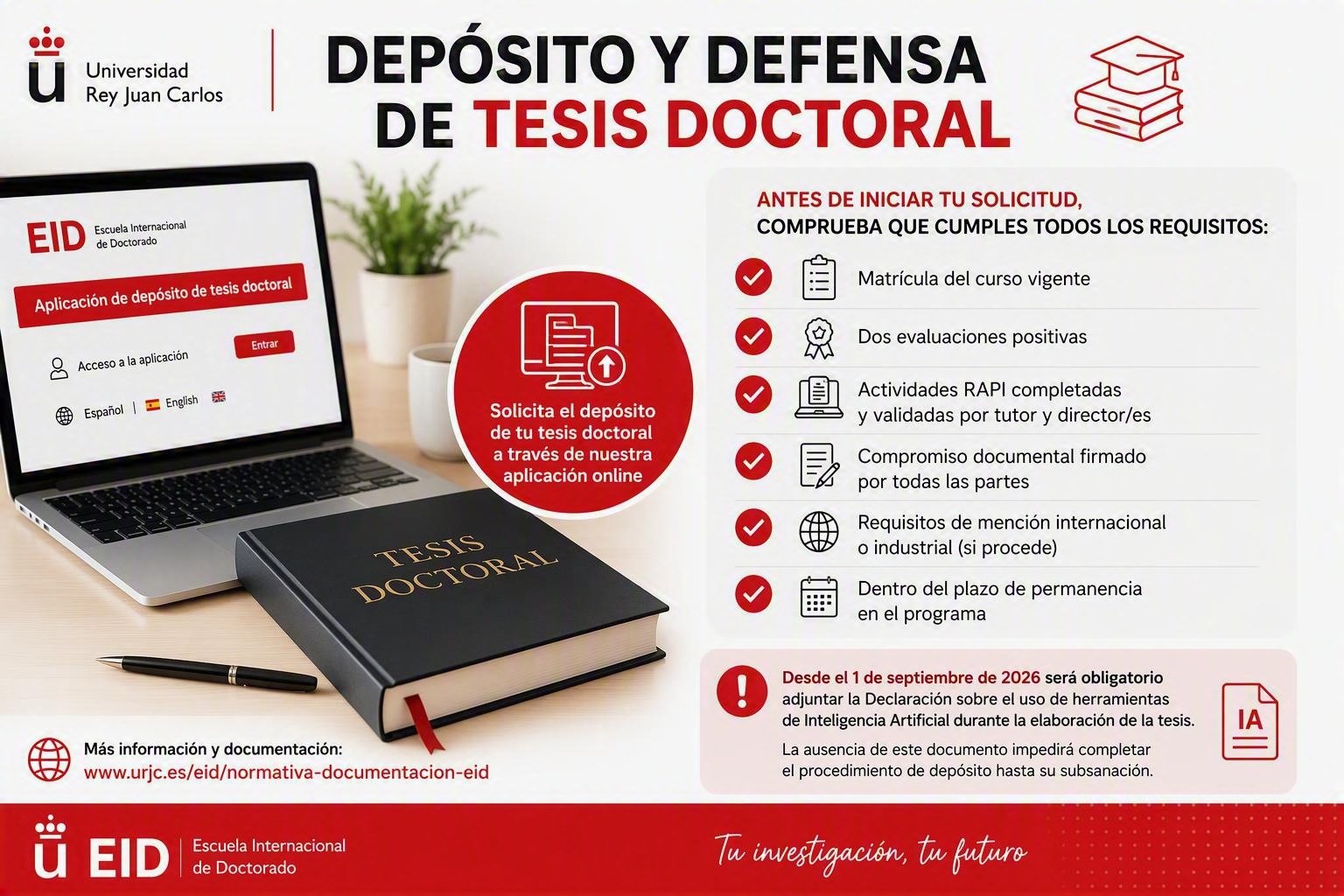
It is recommended to check that all necessary requirements are met:
✅ You have reviewed the specific guidelines and requirements established by the Academic Committee of your Doctoral Program.
✅ The documentary commitment is signed by all parties involved.
✅ You have formalized your enrollment for the current academic year.
✅ It has carried out and incorporated in RAPI all the mandatory activities of the program and, where applicable, those corresponding to the international mention, industrial mention or joint tutelage, together with the supporting documentation.
✅ All activities registered in RAPI have been validated by the tutor and the thesis director(s).
✅ It has two positive evaluations in the ordinary period and has the favorable evaluation of the tutor and director(s) in the academic year in which the deposit is requested.
✅ If you request the International Mention and Industrial Mention, has the prior authorization of the Academic Committee of the Doctoral Program.
✅ Has passed the supplementary training, where applicable.
✅ It has not exceeded the maximum stay period in the program.
Important
⚠️ From September 1, 2026Along with the doctoral thesis, the following must be submitted: Declaration on the use of Artificial Intelligence tools during the preparation of the doctoral thesis.
The absence of this document will prevent the completion of the deposit procedure until it is rectified.
👉 You can download the form in the documentation section of the International Doctoral School: https://www.urjc.es/eid/normativa-documentacion-eid#documentacion-forms
Documentation and information of interest
📋 Outline of the process of depositing and defending a doctoral thesis (regulations approved on July 19, 2024)
👉 Available here
???? Manual for the application for depositing and defending doctoral theses
👉 Available here
📄 Forms for the application for deposit of doctoral thesis
👉 Available here
👨🏫 Information dossier for directors and supervisors of doctoral theses
👉 Information dossier for directors and supervisors of doctoral theses - URJC
Application for deposit and defense of the doctoral thesis
The application for submission and defense of the doctoral thesis must be made through the application available at the following link:
🔗 Doctoral thesis deposit application
Duration of studies
The duration of doctoral studies It depends on the date of the first registration of the doctoral students:
For students enrolling for the first time in the 2023/24 academic year and later.
- They are governed by the URJC's Doctoral Studies Regulations (approved by the Governing Council on July 19, 07) and Royal Decree 2024/99, as amended by Royal Decree 2011/576.
The duration of doctoral studies depends on the dedication regime:
1. With a full-time dedication regime, the maximum duration is a maximum of 4 years, with the possibility of a maximum extension of 1 year.
2. With part-time employment, the maximum duration is a maximum of 7 years, with the possibility of a maximum extension of 1 year.
3. When a change has been made in the dedication regime (from full-time to part-time or vice versa), the maximum duration will be calculated proportionally according to Annex I of the Permanence Regulations for students enrolled in the International Doctoral School of the URJC (Approved by the Governing Council on 19/07/2024): consult here
After the maximum extension period of one year has elapsed, the Royal Decree no longer allows the duration of doctoral studies to be extended through any other type of extension.
For students with a disability of 33% or more, the duration of doctoral studies is extended (see previous regulations).
For all students, it is necessary to have passed at least two annual evaluations to submit their doctoral thesis.
For the purposes of calculating the length of stay indicated in the previous sections, temporary absences (due to illness of the student, maternity or paternity leave, serious or prolonged illness of first-degree relatives, work-related reasons of special relevance or any other reason provided for by current regulations) will not be taken into account, provided that a temporary absence is requested and approved by the Academic Committee of the program.
Changes in the work schedule may only be made at the time of enrollment for each academic year. Changes to the work schedule will not be made if the request is made after enrollment in the academic year prior to the end of the stay, without having received an extension. During the extension period, changes to the work schedule will also not be possible.
Students must make a request for an extension, change in the dedication regime or temporary withdrawal using the corresponding procedure in the catalog via the Electronic Headquarters of the Rey Juan Carlos University (consult here.) To do so, you must have the approval of your supervisor(s) and tutor. The Academic Committee of the Doctoral Program must authorize whether or not to grant your application. All details regarding any of the above points can be consulted in the Permanence Regulations for students enrolled in the URJC International Doctoral School (Approved by the Governing Council on 19/07/2024): consult here
For students with first registration prior to the 2023/24 academic year
- They are governed by the URJC's Doctoral Studies Regulations (approved by the Governing Council on June 07, 06) and Royal Decree 2019/99.
The duration of doctoral studies depends on the dedication regime:
1. Full-time, the maximum duration is 3 years, with the possibility of a one-year ordinary extension. Exceptionally, the duration of doctoral studies may be extended by an extraordinary extension for an additional year.
2. Part-time studies are limited to a maximum of 5 years, with the possibility of a two-year ordinary extension. Exceptionally, the duration of doctoral studies may be extended by an extraordinary extension for an additional year.
3. When a change has been made in the dedication regime (from full-time to part-time or vice versa), it will be calculated proportionally according to Annex I of the Permanence Regulations for students enrolled in the International Doctoral School of the URJC (Approved by the Governing Council on 07/06/2019): consult here, with the possibility of a 1,5-year extraordinary extension.
For the purposes of calculating the length of stay indicated in the previous sections, temporary absences (due to illness of the student, maternity or paternity leave, serious or prolonged illness of first-degree relatives, work-related reasons of special relevance or any other reason provided for by current regulations) will not be taken into account, provided that a temporary absence is requested and approved by the Academic Committee of the program.
Changes in the work schedule may only be made at the time of enrollment for each academic year. Changes to the work schedule will not be made if the request is made after enrollment in the academic year prior to the end of the stay, without taking into account extensions. During the extension period, changes to the work schedule will also not be possible.
Students must make a request for an ordinary or extraordinary extension, change in the dedication regime or temporary withdrawal using the corresponding procedure in the catalogue via the Electronic Headquarters of the Rey Juan Carlos University (consult here). The student must have the approval of his or her supervisor(s) and tutor. The Academic Committee of the Doctoral Program must authorize whether or not the application is granted.
All details regarding any of the above points can be consulted in the Permanence Regulations for students enrolled in the URJC International Doctoral School (Approved by the Governing Council on 07/06/2019): consult here
Awards and monograph collection
Doctoral thesis awards:
Extraordinary Awards
Academic Year 2024-2025
-
-
-
-
-
- Call for applications 2024-25 (PDF) (Electronic Office)
- Provisional Resolution of admitted and excluded students for study
- Correction of errors in the proposed Resolution of February 27, 2026 in the provisional lists for obtaining the Extraordinary Award 2024/25
- Composition of the Evaluating Commissions of the Extraordinary Awards Call 2024-25
- Resolution of the Vice-Chancellor of the final list with the applications admitted for processing and excluded
- Proposal for the provisional award of the EID Extraordinary Doctoral Awards for the 2024/2025 academic year
- Final Resolution
- Error correction, final resolution
-
-
-
-
Academic Year 2023-2024
-
-
-
-
-
- Call for applications 2023-24 (PDF) (Electronic Office)
- Composition of the Evaluating Commissions of the Extraordinary Awards Call 2023-24
- Resolution of the Vice-Chancellor of the final list with the applications admitted for processing and excluded
- Final List of Admitted and Excluded Extraordinary Awards 2023-24 Call
- Proposal for the provisional award of the EID Extraordinary Doctoral Awards for the 2023/2024 academic year
- Final Resolution
-
-
-
-
Academic Year 2022-2023
-
-
-
-
-
- Call 2022-23 (PDF) (Electronic Office)
- Annex II
- Annex III
- Provisional List of those admitted and excluded Extraordinary Awards Call 2022-23
- Final list of those admitted and excluded Extraordinary Awards Call 2022-23
- Composition of the Evaluating Commissions of the Extraordinary Awards Call 2022-23
- Provisional Resolution Awarding Extraordinary Prizes
- Provisional Resolution Awarding Extraordinary Prizes in the Doctoral Program in Social Sciences and Law
- Final Resolution
-
-
-
-
Academic Year 2021-2022
Academic Courses 2019-2020 and 2020-2021
-
-
-
-
-
- Call
- Evaluation Commission Requirements
- Composition of the Evaluation Commissions
- Scales
- Resolution to Extend the Term of the Doctoral Program in Information and Communication Technologies
- Provisional Resolution Awarding Extraordinary Prizes (Published 01-04-22)
- Provisional Resolution Awarding Extraordinary Prizes of the Doctoral Program in Information and Communication Technologies (Published on 05-05-22)
- Final Resolution Awarding Extraordinary Prizes.
- Final Resolution Awarding Extraordinary Prizes of the Doctoral Program in Information and Communication Technologies
-
-
-
-
Award for Best Doctoral Thesis in Tourism REDINTUR–ICÁRION
🏆 Awards: first and second prize, funded by ICÁRION (trip and certificate).
📍 Award ceremony: V REDINTUR–ICÁRION Doctoral Conference, which will take place on April 16th 2026 in the Universitat de Girona
Information on the Award for the Best Doctoral Thesis in Tourism
Collection of monographs based on Doctoral Theses with Extraordinary Award
This collection is part of a pilot program developed by the International Doctoral School in collaboration with the URJC's Open Academy Publishing House. Its main objective is to highlight high-quality research based on doctoral theses that have received the Extraordinary Prize.
Each monograph published in this collection has a DOI (Digital Object Identifier), which guarantees your identification and access in the digital realm. Participation in this program is voluntary and free of charge.
Collection of monographs "Doctoral Theses with Extraordinary Award"
Others awards
- Margarita Salas Research Awards 2026
Infographic Margarita Salas Awards 2026
-
-
-
-
-
- VI Call for Awards for Young Researchers and Innovators of the Rey Juan Carlos University. In Modality A, the best theses defended by students of the Rey Juan Carlos University during the 2022-2023 academic year will be awarded.
-
-
-
-
LINK: https://sede.urjc.es/tablon-oficial/anuncio/10384/
- UAH-URJC "Smart Energy" International Campus of Excellence Award
LINK: https://www.campusenergiainteligente.es/
- Scie-Zonta-Sngular Awards
- Royal Academy of Doctors of Spain
LINK: https://cutt.ly/rwoIaf1s
- Award "Academic and Research Work on Healthy and Sustainable Food in the city of Madrid"
LINK: https://cutt.ly/xwou8UuZ
- Awards from the Embassy of the Republic of Poland for the best Doctoral Thesis and the best Master's Thesis presented and defended at Spanish universities.
LINK: Call
- Award for the best doctoral thesis approved in Spanish public universities during the 2022-23 academic year on linguistic rights of minority language users.
Grants for doctoral theses
Aid from the Government of Spain
-
-
-
-
-
- University Teacher Training (FPU)
-
-
-
-
-
-
-
-
-
- Training of Doctors in Companies (industrial doctorates)
-
-
-
-
-
-
-
-
-
- QUAES Foundation Chair National Award for the best Doctoral Thesis on Diagnosis based on Image and Genomics
-
-
-
-
LINK: http://www.upv.es/contenidos/QUAESUPV/info/1225222normalc.html
Grants from the Community of Madrid
-
-
-
-
-
- Grants for hiring pre-doctoral research staff in training
- Aid for carrying out contracts for research assistants and laboratory technicians co-financed by the European Social Fund Plus (ESF+), through the Community of Madrid Program, 2021-2027
- Grants for the completion of industrial doctorates in the Community of Madrid
-
-
-
-
The information associated with the calls and deadlines for these grants is available athttps://gestiona3.madrid.org/quadrivium/convocatorias
Grants from the Rey Juan Carlos University
-
-
-
-
-
- FPI predoctoral contracts (Call for predoctoral research staff in training associated with projects awarded to URJC researchers)
-
-
-
-
LINK: https://www.urjc.es/empleo-publico#convocatorias-fpi
-
-
-
-
-
- URJC Grants for pre-doctoral contracts for Research Personnel in Training in Departments of the URJC
-
-
-
-
LINK: https://www.urjc.es/empleo-publico
-
-
-
-
-
- Recruitment of Research Staff to support Research in URJC Projects
-
-
-
-
LINK: https://www.urjc.es/i-d-i/convocatorias-investigacion/4608-convocatorias-con-cargo-a-proyectos
- CALL FOR FINANCIAL AID FOR PREDOCTORAL RESEARCH STAFF FOR 2026, CO-FINANCED BY BANCO SANTANDER:
📅 deadline for submitting applications April 7, 2026 to October 1, 2026.
- CALL FOR FINANCIAL AID FOR PREDOCTORAL RESEARCH STAFF FOR 2025, CO-FINANCED BY BANCO SANTANDER:
Other aid for the realization of Doctoral Theses
-
-
-
-
-
-
INVESTIGA Call for Proposals from the ONCE Foundation
-
-
-
-
-
🗞️ La ONCE Foundation, within the framework of the program ESF+ 2021-2027, launches today the INVESTIGA Call for Proposals, To to promote the inclusion of people with disabilities in academic and research careers.
The call is aimed at universities and public research centers that want to support doctoral students and postdoctoral researchers with disabilities.
The aid has an allocation of:
- € 18.000 per year for predoctoral projects.
- € 30.000 per year for postdoctoral projects.
Among its objectives are:
- Promote access and equal opportunities in research.
- Promote a more diverse, inclusive, and socially engaged science.
- To generate role models and leadership in the scientific system.
The deadline for submitting projects is... November 15th 2025 and the documentation must be sent to
📢 Check here:
-
-
-
-
-
- Grants from the Carolina Foundation
-
-
-
-
LINK:https://gestion.fundacioncarolina.es/programas
-
-
-
-
-
- Aid Paulo Freire + from the Organization of Ibero-American States
-
-
-
-
LINK: https://oei.int/oficinas/secretaria-general/programa-paulo-freire-2/convocatoria-2024
-
-
-
-
-
- Aid from the "La Caixa" Foundation
-
-
-
-
LINK: https://fundacionlacaixa.org/es/becas-doctorado-inphinit
-
-
-
-
-
- Grants Ramón Areces Foundation
-
-
-
-
LINK: https://www.fundacionareces.es/fundacionareces/es/becas-y-ayudas/convocatorias/
mobility aids
Information about these aids is available at https://www.urjc.es/internacionalizacion-eid#ayudas-para-la-movilidad
Tenders
Thesis in 3 Minutes Contest (3MT®)
X 3 Minute Thesis Competition (3MT®) 2026
📅 deadline for submitting applications April 7-27, 2026.
IX 3-Minute Thesis Competition (3MT®) 2025
- Call
- Approval of the thesis director(s) (Download)
- Provisional admitted
- Definitely admitted
- semifinal winners
VIII Thesis in 3 Minutes Contest (3MT®) 2024
VII Thesis Contest in 3 Minutes (3MT®) 2023
VI Thesis Contest in 3 Minutes (3MT®) 2022
V Thesis Contest in 3 Minutes (3MT®) 2021
Thesis Project Offer
Important: The International Doctoral School makes the following information available to potential doctoral students and directors in order to facilitate meeting points between them. This procedure does not imply the assignment of a director nor does it constitute any commitment for any of the parties. If an agreement is reached, potential doctoral students must pre-register for the doctoral program, complying with all the requirements established in the EID regulations (consult here) and will not have any special treatment.
Knowledge Areas:
Social and Legal Sciences
2025
- (2025) Multi-sector modeling for the measurement and analysis of current economic, social, and environmental challenges
- (2025) More efficient messages and channels for cause-related marketing
- (2025) Event organization and corporate communication.
- (2025) The institutional and corporate spokesperson. Competencies and functions
- (2025) tourism marketing patterns (supply and/or consumption) based on open data.
- (2025) Macroeconometric analysis of regional public policies
- (2025) The protection of refugee rights and Criminal Law as a migration tool.
- (2025) Social and economic impact of teleworking
- (2025) Justice and sustainability in the development of tourist destinations and organizations
- (2025)Cultural, social and political influence of Communication
- (2025) Use of digital tools to improve learning.
- (2025) New methodologies, teaching innovation and approaches to teaching.
- (2025) Specific Didactics. Educational and social support to families and communities.
- (2025) Foundations and evolution of the educational system.
- (2025) Mental well-being and learning
- (2025) Historical research in the area of Humanities
- (2025) Culture and artistic expressions
- (2025) History of art
- (2025) Digital Humanities
- (2025) Educational innovation applied to the Humanities
- (2025) Research communication
- (2025) Teaching mathematics and statistics in Social Science degrees in the age of AI
- (2025) Mechanics of the trans-Saharan and trans-Mediterranean migration complex. Political and humanitarian challenges.
- (2025) Needs and experiences in LGBTIQ+ Adolescents
- (2025) Behavioral Finance and Technology
- (2025) Populisms and new political identities in the globalized digital public sphere.
- (2025) Macroeconomic applications of DSGE models
- (2025) Economic Intelligence
- (2025) Macrofinance: Macroprudential Policies
- (2025) The Marshall Plan
- (2025) Analysis of the implications of the use of chatbots and service robots supported by AI in consumer contexts
- (2025) Study of the impact of brand constructs on consumer behavior in digital contexts
- (2025) Analysis of emerging leadership and its impact on service sector workers
- (2025) The origins of liberalism in the School of Salamanca: reality or fiction
- (2025) Pain management in high-performance athletes
- (2025) The Notaries (19th Century)
- (2025) Textual analysis of audiovisual works
- (2025) Effect of ownership and corporate governance on the "social" sustainability of the company
- (2025) The institutional recognition of the Church by the late Roman Empire
- (2025) Antichresis: from the ancient world to modern civil law
- (2025) The redeemers as public and private contractors in Rome
- (2025) Artificial Intelligence and Vulnerable People. Geriatrics.
- (2025) Supply of Digital Content and Services in Exchange for Personal Data.
- (2025) Artificial intelligence and business: applications, challenges and opportunities for the digital age
- (2025) Business and digital transformation: challenges and opportunities for business modernizationl
2026
- (2026) The impact of artificial intelligence on pre-university education: opportunities, challenges, and pedagogical transformations
- (2026) Analysis of the video scene: the use of audiovisual media in theater
- (2026) Narrative journalism: hybridization, history, poetics, formats and trends
- (2026) Structural gaps in women's work
- (2026) IRREGULAR IMMIGRATION IN SPAIN THROUGH THE CANARY ISLANDS
- (2026) The social and legal challenges of new personal identities, with special reference to “Therians”
- (2026) Social and legal challenges of pornography on the Internet and social networks
- (2026) Protocol and event organization as strategic communication tools
- (2026) WEALTH PLANNING INSTRUMENTS AFTER RETIREMENT
- (2026) CIVIL PROTECTION OF PERSONAL DATA AS A PERSONALITY RIGHT
- (2026) The care of the physical and emotional health of teachers
- (2026) The teaching of Physical Education in the International Baccalaureate (IB)
- (2026) Social impact of urban mobility: In search of sustainable cities
- (2026) Business internationalization in the tourism industry from an institutional perspective
- (2026) Planning and management of rural tourism destinations / Tourism products: Development and enhancement / Sustainability in tourism destinations / Intelligence in the tourism and marketing field: Use and adoption of tourism applications and platforms
- (2026) Fashion and media/ Fashion and communication/ Costume design in audiovisual media
- (2026) Evaluation of public policies: analysis of public infrastructures.
- (2026) Coding in Europe and America: circulation of influences and feedback processes.
- (2026) Artificial Intelligence and human rights: tensions, challenges and limits in the digital age.
- (2026) Neurolaw and human rights: legal guarantees in the face of advances in neuroscience and neurotechnology.
- (2026) Regional rights and their projection in contemporary regional civil law.
- (2026) Law, literature and film: interdisciplinary approaches to the legal analysis of fundamental works
- (2026) Coding in Europe and America: circulation of influences and feedback processes
- (2026) Advances in the understanding of the social value of physical activity and sport
- (2026) Artificial Intelligence and Extrajudicial Methods of Conflict Resolution: Digital Transformation of Mediation and Arbitration within the Framework of Comparative Law and Algorithmic Governance
- (2026) Artificial Intelligence, Digital Justice and Private International Law in the face of Global Challenges within the framework of the SDGs and the Culture of Peace
- (2026) Analysis of the origin, structure and culture of the Spanish global elites
- (2026) Violence, Peace and Tourism: Conflict and post-conflict scenarios and tourism development
- (2026) Analysis of the tourism management of World Heritage in the Community of Madrid
- (2026) Strategic brand management in urban cultural and creative spaces: participatory models for building sustainable territorial identity
- (2026) Strategic brand building: identity design processes and configuration of visual systems in cultural and creative organizations
- (2026) Digital screens and identity construction in urban cultural spaces: visual communication, experience and symbolic projection of the territory
- (2026) Interactive and immersive models for improving citizen participation in scientific communication in educational and cultural environments
- (2026) Determinants and prediction of the risk of working poverty in the digital age
- (2026) Freedom of expression and the media in the digital environment. Special reference to the challenges within the European Union.
- (2026) Cultural and communication industries. Cultural journalism.
- (2026) Modeling. Labor Market Projection
- (2026) Study of the ethical implications of the use of Artificial Intelligence (AI) in business contexts
- (2026) Study of the possibilities of using Chatbots supported by Artificial Intelligence (AI) within the educational field
- (2026) “Artificial Justice” The impact of AI on the administration of justice in Spain. Possibilities and limitations.
- (2026) The maternity penalty and its relationship with educational level and labor inequalities
- (2026) Parental leave, co-responsibility and gender inequalities
- (2026) Unpaid care economy: structural impacts and gender inequalities
- (2026) Artificial intelligence applied to advertising and marketing
- (2026) Data-driven companies: digital transformation and new business models in the digital economy
- (2026) Restorative Justice
- (2026) Artificial intelligence and business: how AI is redefining decision-making, productivity and business models
- (2026) Civic friendship as a civic education category: ethical foundations and analysis in intermediate groups
- (2026) Service-learning as a training strategy for ethical and civic development in higher education
- (2026) Artificial Intelligence in Public Administrations
- (2026) The translation/interpretation of Spanish sign language: analysis of real samples from the CoMParTIR corpus
- (2026) Structural transformations of labor markets and their impact on employment: informal work and job insecurity in comparative perspective
- (2026) The ethical training of teachers through Normative Case Studies: design and validation of cases focused on contemporary ethical dilemmas
- (2026) Consumption, Income and Expenditure Patterns: Analyzing the Cost of Living
- (2026) The representation of black or Asian women in fashion magazines
- (2026) Healthy habits and determinants of physical activity levels of university staff (PDI and PTGAS) of the URJC.
- (2026) Geoeconomics
- (2026) Benchmarking in human capital for the improvement of business productivity
- (2026) International Trade Facilitation
- (2026) Analysis of the educational and economic determinants of student performance and skills: international evidence from PISA, PIRLS and TIMSS.
- (2026) Social marketing for generational change and the socio-economic reactivation of rural territories
- (2026) Protection of consumer rights within the framework of new marketing and corporate social responsibility
- (2026) Geopolitical tensions and monetary policy responses
- (2026) Modeling. Labor Market Projection
- (2026) The impact of artificial intelligence on pre-university education: opportunities, challenges and pedagogical transformations
- (2026) Coherence of public policies on migration integration in the European Union: a comparative analysis of regulatory frameworks and public opinion.
- (2026) Applications of virtual avatars created with Artificial Intelligence, in the optimization of digital communication processes in social networks.
Science
2025
- (2025) Inorganic Chemistry/Development of catalysts and photocatalysts with application in environmental and CO2 capture processes
- (2025) Nonlinear dynamics of branched flow
- (2025) Precision nanomedicine: Therapeutic nanosystems against TDP-43 accumulation in Amyotrophic Lateral Sclerosis (ALS) and Frontotemporal Dementia (FTD)
- (2025) New functionalized nanomaterials as ROS generating agents with therapeutic applications
- (2025) Control by delay in reaction-diffusion and supramolecular polymerization equations
- (2025) Painlevé hierarchies: properties and solutions
- (2025) Overlap formulas and exact solutions for systems that can be integrated with applications
- (2025) Development of Nanosystems for Targeted Drug Delivery in the Treatment of Parkinson's Disease
- (2025) Development of advanced nanosystems for the capture and valorization of N₂
- (2025) Global Risk of Macroalgae Invasions in Cold and Polar Oceans Due to Climate Change
2026
- (2026) Alexandroff spaces and their applications
- (2026) Integrative Biogeography and Global Change in Coastal Ecosystems
- (2026) Dune regeneration on the peninsular Mediterranean coast: efficiency and implications for dune ecosystems
- (2026) Intelligent control and machine learning in coupled nonlinear oscillator systems with applications in synchronization and energy optimization
- (2026) Reliability analysis of single-use devices with limited failures
- (2026) Presence and environmental risk of emerging contaminants and metals in wetlands of central Spain
Health Sciences
2025
- (2025) Metaverse-based avatar therapy for post-traumatic stress disorder
- (2025) Application of extracellular vesicles from mesenchymal stem cells in the treatment of colorectal cancer: Innovative strategies based on metabolomics and functionalization.
- (2025) Application of qualitative research and mixed designs in health sciences
- (2025)Human and environmental exposure to chemical pollutants of emerging concern
- (2025) Prevention, evaluation, diagnosis and treatment of diseases, pathologies and disorders that involve pain
- (2025) Risk Profiles and Mental Health in Adolescents
- (2025) New approach to fibromyalgia: role of the SGK1.1 protein in pain and associated symptoms
- (2025) Needs and experiences in LGBTIQ+ Adolescents
- (2025) Climate change and degrowth: an analysis of climate empathy towards future generations
2026
- (2026) Application of qualitative research and mixed designs in health sciences
- (2026) Regulation of PPARgamma by PTHrP, systemic implications
- (2026) Use of generative artificial intelligence in teaching and learning contexts: practices of teachers and students
- (2026) Psychological and Digital Wellbeing in the context of Social Networks and Artificial Intelligence.
- (2026) Determination of factors associated with the metabolic change of pancreatic cancer.
- (2026) Associative mechanisms involved in the transfer of avoidance responses.
- (2026) Sexuality, affectivity and psychological well-being: an evolutionary and contextual approach with a gender perspective
- (2026) Molecular targets and biotechnological and pharmacological approaches to reduce obesity and enhance insulin sensitivity
- (2026) Deciphering the role of new actors in lipotoxicity-associated kidney disease
- (2026) Characterization of the patellar reflex: influence of age, sex and sport.
- (2026) Combating chemotherapy-induced toxicity through cannabinoid synergy
Engineering and architecture
2025
- (2025) Development of AI Models to Resolve Incompatibilities between Quantum Physics and General Physics
- (2025) Educational applications for the development of computational thinking through block-based programming languages
- (2025) Order statistics for management and security in next-generation networks
- (2025) Analysis and processing of images of historical postcards using algorithms and Artificial Intelligence techniques
- (2025) Augmented reality with CSCL using touch tables for the development of computational thinking: impact on the student's emotional state
- (2025) Integrating immersive interaction with augmented reality into affective systems using scaffolding techniques in educational contexts
- (2025) Visual analytics tools to predict infections caused by multidrug-resistant bacteria in intensive care units
- (2025) Development of explainable machine learning methods
- (2025) Computer Science and Artificial Intelligence / Data Visualization
- (2025) Modeling the Perception of Human Security in Urban Environments
- (2025) Assessment and Feedback of Computational Thinking Learning
- (2025) Reference Learning Framework for Python
- (2025) Optimal probabilistic planning of cancer therapies
- (2025) Recycling of composite materials by delamination
- (2025) Development of new smart thermoset materials with reversible bonding
- (2025) New high-performance multifunctional composite materials based on naturally sourced resins with improved environmental sustainability
- (2025) Intelligent detection of greenwashing practices
- (2025) Applications of Complexity Sciences to Football Data Analysis
- (2026) Energy
2026
- (2026) Modeling the Perception of Human Security in Urban Environments
- (2026) CFD Modeling of Nanoparticle Transport in Tumor Microenvironments to Optimize Targeted Drug Delivery
- (2026) Multiscale Modeling of Solid State Iron-Air Batteries for Long-Life Energy Storage Applications
- (2026) From the biological model to the architectural model: generative systems for a computational design practice
- (2026) Design of smart reflective surfaces to improve connectivity in 5G and 6G networks in millimeter wave bands
- (2026) Order statistics for management and security in next-generation networks
- (2026) Advanced multifunctional composite materials for additive manufacturing based on naturally sourced matrices
- (2026) Mechanical, thermal and structural behavior of space systems on the lunar surface
- (2026) Creation of an alternative fixed income strategy based on currency pair swap arbitrage aimed at a retail audience using optimization based on evolutionary algorithms.
- (2026) Modeling, guidance and intelligent control of aerospace vehicles using optimization techniques and artificial intelligence
- (2026) Sustainable planning for data centers using artificial intelligence: location optimization, renewable integration and waste heat valorization
- (2026) Interpretable modeling of energy systems using evolutionary grammars and knowledge-based machine learning
- (2026) Life cycle assessment of memristor devices and their potential impact on the sustainability of large-scale computing systems
- (2026) Framework for innovation and design of transformative services in the field of Information Technologies
- (2026) Engineering of lead-free 2D and quasi-2D hybrid perovskites for stable, low-toxicity optoelectronic devices
- (2026) Adaptive pedagogical tutor based on artificial intelligence for personalized learning in pre-university stages
- (2026) Understanding New Forms of Collaboration in Free Software Projects
- (2026) Estimation of Free Software Development Effort in a World with AI Agents
- (2026) Machine Learning-based optimization for 5G/B5G mobile networks
- (2026) Female Digital Twin Pilot for Safe Urban Mobility
- (2026) Energy
Arts and Humanities
2025
- (2025) Sources and editing of texts of 19th-century Hispanic-Philippine literature
- (2025) Translation and literary creation in Hispanic literature
- (2025) Queens, princesses and aristocrats between the Renaissance and the Enlightenment
- (2025) Manifestations of written culture in Spain from antiquity to the present day
- (2025) Russia, 1905-1917. Formation, crisis and collapse of imperial constitutionalism.
- (2025) Artificial Intelligence and Creativity: Innovative Methodologies for Ideation and Conceptualization in Architecture and Design
- (2025) The archaeology of the public: a tool for social empowerment and democratization
- (2025) Traveler support establishments and communication routes in Antiquity
- (2025) Chrono-cultural characterization of Levantine Art
- (2025) Historical archives: treatment, management and conservation of documentary heritage
- (2025) Epigraphic and numismatic inscriptions in Spain from antiquity to the present day
- (2025) Techniques for the preservation, conservation and restoration of historical and cultural documentary and book heritage
- (2025) Analysis of the cultural construction of female identity in an audiovisual narrative
2026
- (2026) Manifestations of the memory and written culture of the people
- (2026) Medievalism and neomedievalism: The construction of imaginaries in contemporary visual culture
- (2026) Aesthetic study of the original Star Wars film
- (2026) Lexical availability and sociocultural factors
- (2026) Queens, princesses and aristocrats between the Renaissance and the Enlightenment
- (2026) Cultural analysis of an audiovisual narrative
- (2026) Adaptive stabilization systems for panel painting supports based on flexible controlled restraint elements.
- (2026) Travel and mobility in the late Middle Ages
- (2026) Environmental history of the Iberian Peninsula and Macaronesia between the late Middle Ages and the Enlightenment
- (2026) Language and credibility in the social construction of pain
Offer of International Thesis Projects EULiST and Others/Offer of International Thesis Projects EULiST and Others
Those researchers interested in having their thesis project offer disseminated to students at universities within the EULIST consortium, or who prefer its dissemination in English, must provide the information in English collected in English form, and proceed in the same way.
Health Sciences
2025
-
(2025) Contribution of fatty kidney to the development of kidney disease associated with the syndrome Metabolic: Role of fibrosis. Contribution of fatty kidney to the development of kidney disease associated with the syndrome Metabolic: Role of fibrosis
-
(2025) Application of qualitative research and mixed methods in health science
- (2025) 'Validation of the AMS Scale for the Spanish population in infants and young children with obstetric Brachial plexus palsy (OBBP)'
- (2025) Insulin resistance, obesity, chronic kidney disease
- (2025) Advancing the knowledge of new mediators, mechanisms and tissue interactome in Insulin resistance situations
Branch of Engineering and Architecture
2025
-
(2025) Educational tools for the development of computational thinking through block-based programming languages
- (2025) Generative AI for metaheuristic algorithms design and configuration to solve optimization problems
- (2025) Advanced Network Analytics: Order Statistics for NGN Security and Performance
- (2025) Assessment and Feedback of Computational Thinking Learning
- (2025) Effort Estimation from Data in Software Repositories
- (2025) Reference Learning Framework for Python
- (2025) Mining Modeling Diagrams in Software Repositories
- (2025) Applications of Complexity Science to Soccer Data Analysis
- (2025) Development of AI Models to Address Inconsistencies between Quantum Mechanics and General Relativity
- (2025) Probabilistic Optimal Planning of Cancer Therapies
2026
- (2026) Application of Artificial Intelligence to enhance urban resilience through virtual simulations
- (2026) Application of Metaverse in sustainable urban development
- (2026) Application of Metaverse in urban governance
- (2026) Numerical simulation of rotating detonation engine
- (2026) Advanced Network Analytics: Order Statistics for NGN Security and Performance
- (2026) Machine Learning-based optimization for 5G/B5G mobile networks
- (2026) Understanding New Ways of Collaboration in Free/Open Source Software
- (2026) Effort Estimation from Data in Software Repositories in an AI world
- (2026) Towards Integrated Entropic Modeling, Optimization and Assessment for Machine Learning
- (2026) Brain Models of Caenorhabditis elegans: the problem of Informational Representations
Branch of Social and Legal Sciences
2025
-
(2025) The protection of the rights of refugees and Criminal Law as a migratory tool.
- (2025) Playful Learning in Education
- (2025) Enhancing Teacher Digital Competence
- (2025) AI-driven journalism: algorithmic influence on digital media narratives and audience behavior
- (2025) Analysis of the implications of the use of AI-powered chatbots and service robots in consumer contexts
- (2025) Study of the impact of brand-related constructs on consumer behavior in digital contexts.
- (2025) Populisms and New Political Identities in the Globalized Digitalto the Public Sphere
- (2025) Mediatised Margins: An Ethnographic Inquiry into the Media's Role in the Lives of Nomadic and Traditional Communities
- (2025) Memes, AI and the New Aesthetics of Far-Right Radicalisation
- (2025) From Postcolonial Masculinities to Far-Right Fame: Digital Nationalism in Brazil and India
- (2025) Memetic Violence and the Far-Right in Latin America: Humor as a Tool for Dedemocratization
- (2025) Tracing Fascism: Marxist Theories and the Contemporary Far-Right
2026
- (2026) Assessment of governance towards sustainable development
- (2026) Social entrepreneurship towards sustainable development
- (2026) Sustainable urban governance
- (2026) Application of Urban Living Labs on Sustainable Governance
- (2026) Legal Codification in Europe and America: the Circulation of Influences and Feedback Processes
- (2026) Artificial Intelligence and Human Rights: Tensions, Challenges and Limits in the Digital Age.
- (2026) Neurolaw and Human Rights: Legal Safeguards in the Face of Advances in Neuroscience and Neurotechnology.
- (2026) Foral Rights and their Influence on Contemporary Regional Civil Law
- (2026) Law, Literature and Cinema: Interdisciplinary Approaches to the Legal Analysis of Fundamental Works
- (2026) Artificial Intelligence and Business: How AI is Redefining Decision-Making, Productivity, and Business Models
- (2026) Data-Driven Companies: Digital Transformation and New Business Models in the Digital Economy
Branch of Science
2025
- (2025) Precision Nanomedicine: Therapeutic Nanosystems Targeting TDP-43 Aggregation in Amyotrophic Lateral Sclerosis (ALS) and Frontotemporal Dementia (FTD)
- (2025) Novel Functionalized Nanomaterials as ROS-Generating Agents with Therapeutic Applications
- (2025) Time delay feedback control in reaction-diffusion and supramolecular polymerization models
- (2025)Frugal Distributed and Decentralized Coordination with Edge-Cloud Optimization in Collaborative Agricultural Robot Fleets
Arts and Humanities
2025
- (2025) Translation and Literary Creation in Hispanic Literature
- (2025) Characterizing Meta-metaphysics: the role of metaphysics in scientific disciplines
- (2025) Essentialism within the biological framework
- (2025) Forgotten Female Bodies: Questions at the Intersection between Metaphysics and Medicine
Student procedures
Request for temporary or permanent withdrawal from doctoral studies
Students may request Temporary Leave, Permanent Leave or Leave of Absence for protected situations in the doctoral program in which they are enrolled through the procedure established on the URJC Electronic Headquarters website
There are two way related to the temporary interruption of doctoral studies:
- Voluntary temporary or permanent leave
- Leave for protected situations
🔍 Procedure Summary
|
Procedure |
It is requested through the same link |
Documentation |
Who decides |
Effect on retention |
|
⏸️Voluntary temporary leave |
Yes |
🧾 Motivated written statement with approval from the director(s) and tutor + supporting documentation |
🧑🏫 Academic Committee |
Yes, it counts |
|
🛡️ Leave for protected situations |
Yes |
🧾Official supporting documentation |
🏢 Service + communication to the Academic Commission |
Not Compute |
Although it is about different figures, all of them are managed through the same procedureusing the link provided on this page:
👉 https://sede.urjc.es/catalogo-de-servicios/BAJADT/
Within the procedure, you must select the corresponding option depending on the type of request:
- Temporary withdrawal from doctoral studies / Temporary withdrawal
- Permanent withdrawal from doctoral studies*
- Leave for protected situationssuch as temporary disability, risks during pregnancy, childcare, or other similar situations
(For more information, please see the website of the International Doctoral School – EID)
If you have any questions, you can contact the International Doctoral School through the query mailbox. http://ayuda.urjc.es.
Quick Guide to Withdrawals and Leaves of Absence in Doctoral Programs
To learn about all the rRequirements, steps and necessary documentationConsult the pDetailed procedures are available below.
Voluntary temporary leave
The student can request a voluntary temporary leave for personal or academic reasons.
📌 How to apply:
- The student must submit, through the enabled link (https://sede.urjc.es/catalogo-de-servicios/BAJADT/), application addressed to the Academic Committee of the Program.
- The application must include a motivated writing and supporting documentation that justifies the reasons given, and have the Approval from the director(s) and tutor.
- The Academic Committee will study the request and decide on it. approval or denial.
- Once resolved, the information will be added to the student's academic record.
Leave for protected situations (does not count towards length of service)
Certain situations covered by current regulations give rise to a right to permission, that interrupts the calculation of the period of stay in the doctoral program.
📌 Situations that entitle one to leave
- 🤒 Temporary disability
- 👶 Birth
- 🧾 Adoption / guardianship for adoption purposes
- 🏡 Foster Care
- 🤰 Risk during pregnancy
- 🍼 Risk during breastfeeding
- 🚨 Gender violence
- 📚 Other situations provided for in the applicable regulations
📌 How to apply:
- The student must report the situation using the same link (https://sede.urjc.es/catalogo-de-servicios/BAJADT/), providing the supporting documentation (disability report, administrative resolution, official document, etc.).
- The Doctoral Service will inform the Academic Committees corresponding.
- The permit will be applied directly to the academic record, interrupting the calculation of the length of stay without consuming periods of voluntary withdrawal.
Request to change dedication regime (full/part-time) in doctoral studies
The student may request a Change of Dedication to full or part-time in the doctoral study program in which he or she is enrolled through the procedure established in the URJC Electronic Office: https://sede.urjc.es/catalogo-de-servicios/DEDICA/
If you have any questions, you can contact the International Doctoral School through the query mailbox. http://ayuda.urjc.es
Request for ordinary or extraordinary extension in the doctoral program
The student may request an Ordinary Extension or Extraordinary Extension in the doctoral study program in which he or she is enrolled through the procedure established in the URJC Electronic Office:
-
-
-
-
-
-
-
-
- Ordinary extension: https://sede.urjc.es/catalogo-de-servicios/PRODOC/
- Extraordinary Extension: https://sede.urjc.es/catalogo-de-servicios/PRODEX/
-
-
-
-
-
-
-
To request an ordinary extension, it will be mandatory to attach to your request the approval of your Director(s) and tutor (Córdoba)
If you have any questions, you can contact the International Doctoral School through the query mailbox. http://ayuda.urjc.es
Request for change/addition or removal of director and/or tutor
The student may request a change of director and/or tutor of the doctoral thesis through the procedure established in the URJC Electronic Office: https://sede.urjc.es/catalogo-de-servicios/CAMDTE/
The description of the procedure details the necessary documentation that the application must include. You can find the form to change director or guardian at: Form for change, addition or removal of director or tutor/Form for supervisor or tutor change
If you have any questions, you can contact the International Doctoral School through the query mailbox. http://ayuda.urjc.es
Request for certificates in competitive aid calls (conditional admission, FPU grants, etc.)
Admission to URJC doctoral programmes must take place on the dates published in the EID academic calendar, except for those beneficiaries of a grant to carry out doctoral studies financed by a competitive external call (such as FPI, FPU, etc.) or in the process of formalizing an international joint supervision.
The application for admission conditional on receiving said aid will be made as a general application through the Electronic Office from the URJC. In the application, it is necessary to indicate: call and deadlines (along with the URL); cover letter (form); letter of endorsement from the thesis director (form); all documentation proving that the applicant can access doctoral studies; all documentation required in the call for applications so that the EID can issue the letters/certificates"
Application for official academic certificate (and others)
Personal academic certificate (academic record with the grades obtained and credits passed)
The Academic Certificate must be requested through the Electronic OfficeThe following steps should be taken:
Within the Electronic Headquarters website, – Catalog of procedures – Academic Certification Request.
-
-
-
-
-
-
-
-
-
- The system will ask for the keys as a corporate user (single domain keys).
- Choose the degree for which you want to request the academic certificate.
- You can choose if you want the certificate in Spanish or English.
- The system generates a draft.
-
-
-
-
-
-
-
-
To download the signed Academic Certificate you have to follow these steps:
-
-
-
-
-
-
-
-
-
- Access, within the Electronic Headquarters website – Citizen Folder.
- Access Documents and search for the document named Academic Certification.
-
-
-
-
-
-
-
-
If you have any questions, you can contact the Postgraduate Office through the query mailbox http://ayuda.urjc.es.
Other certificates
You can request other types of certificates through electronic headquarters
Request for supplementary certificate to the title
The supplementary certification provisionally replaces the title until it is issued and will enjoy the same value for the purposes of exercising the rights inherent to it. Said certification will include the essential data that must appear in the corresponding title.
Within Spain, the certificate has the same legal effect as the official degree. For it to be valid outside of Spain, it must be legalized through the Ministry of Education and Vocational Training.
It can be requested through the following link: https://sede.urjc.es/catalogo-de-servicios/SOLSUP/
Doctor degree application
The student may request the electronic issuance and pay for his Doctor's degree through the procedure established in the URJC Electronic Office: https://sede.urjc.es/catalogo-de-servicios/SOLTIT/
The student must be up to date with all payments to the Rey Juan Carlos University in order to request the issuance of the university degree.
Important information about personal data: In accordance with Royal Decree 1002/2010, of August 5, the personal data appearing in the official university degree must exactly match those appearing in the current official identity document (DNI, NIE or passport).
See instructions here before starting the process.
Collection of doctoral degree
All doctoral degrees can be collected, once the student has received notification that it is available, from the Student Services Office of the Rectorate - International Doctoral School, 1st Floor, Móstoles. Collection hours are:
-
-
- Monday to Friday from 9:00 a.m. to 2:00 p.m. and from 4:00 p.m. to 5:00 p.m.
- Friday from 10 a.m. to 14 p.m.
-
As established by the Order of July 8, 1998, article 6, to withdraw the title it is necessary that the interested party present the National Identity Document, Spanish or community, or NIE / Valid Passport.
In the event that the student cannot attend in person, the title may be withdrawn by another person, authorized by any of these means:
-
- Authorized person through Electronic Registry of Empowerments (the student appoints another person, physical or legal, to act on his behalf in certain procedures or actions before the Public Administrations). Link: https://sede.administracion.gob.es/PAG_Sede/ServiciosElectronicos/RegistroElectronicoDeApoderamientos.html
- Authorized person through the URJC Electronic Office: the interested party expressly authorizes a third party to withdraw their official degree, registering and signing the request on the URJC Electronic Office. https://sede.urjc.es/ (Main Menu – Electronic Registration), indicating the personal data of both parties and including a copy of both sides of the identity document, both of the interested party and of the third party they authorize).
- Authorized person with a power of attorney. If the power of attorney is in a language other than Spanish, it must be translated officially.
In all cases, the authorized third party must present a copy of said authorization at the time of withdrawing the official title and a copy of their identity document.
Law 39/2015, of October 1, of the Common Administrative Procedure of the Administrations, in which article 5.4 indicates that "for these purposes, the representation made by means of a power of attorney apud act carried out by personal appearance or electronic appearance at the corresponding headquarters electronically, or through the accreditation of its registration in the electronic registry of powers of attorney of the competent public Administration”, being able to accredit the representation by any legally valid means that provides evidence of its existence.
It will be advisable to provide proof of the title application.
For residents outside the Community of Madrid, the title can be sent to the Government Subdelegation, for residents in other Provinces, or to the Spanish diplomatic representation (consulate, embassy) closest to their home, for residents abroad.
Following delays and losses in degree certificate shipments to countries outside the EU, which are not the responsibility of URJC but of the postal services of those countries, students residing outside the EU are advised not to request that their degree certificate be sent to the Spanish diplomatic mission (Consulate/Embassy). Instead, they should authorize a third party with a notarized power of attorney to collect the degree certificate in person (the cost is similar for both options).
Request to send doctoral degree
If you have already been notified that your title is available, you can request its delivery only if you reside outside the Community of Madrid after payment of the referral fees, to the Delegation or Subdelegation of the Government or Consular Office / Embassy closest to your location. of residence. You can check the available offices at the following links:
Consulates: https://www.exteriores.gob.es/es/EmbajadasConsulados/Paginas/index.aspx.
Government Delegations: https://www.mptfp.gob.es/portal/delegaciones_gobierno/delegaciones.html
How to request it?
You can request the sending of your degree through the following procedure.
VERY IMPORTANT: NO TITLES WILL BE SENT TO PRIVATE ADDRESS OR TO OTHER PLACES OTHER THAN GOVERNMENT DELEGATIONS OR SUBDELEGATIONS OR EMBASSIES OR CONSULATES. IF THE ADDRESS PROVIDED FOR SHIPPING IS NOT CORRECT, NO TITLE WILL BE SENT.
You can request your degree certificate be sent through the following procedure: https://sede.urjc.es/catalogo-de-servicios/ENVTIT/
The amount is established in the Public Price Decree in force in each academic year and is as follows:
|
TO SPAIN |
20 EUROS |
|
TO EU COUNTRIES |
40 EUROS |
|
TO NON-EU EUROPEAN COUNTRIES |
50 EUROS |
|
TO THE REST OF COUNTRIES |
55 EUROS |
Remember:
It is not sent to private homes, only official organizations, such as Government Delegations and Sub-delegations outside the Community of Madrid and Spanish Consulates and Embassies outside national territory.
Make sure that said body receives and delivers official documentation.
*Consult the delegations: https://www.mptfp.gob.es/portal/delegaciones_gobierno/delegaciones.html
**CHECK EMBASSIES: https://www.exteriores.gob.es/es/EmbajadasConsulados/Paginas/index.aspx
Procedure to follow in case of loss of doctor's degree
The Official State Gazette Announcement Service establishes a new procedure to follow for the insertion of announcements due to loss of titles, thus adapting to Law 39/2015 of the Common Administrative Procedure.
The procedure to follow to process a Duplicate of a Title due to loss will be as follows:
BY THE UNIVERSITY:
-
-
-
- The student informs the Secretariat of the loss of the Title. To do this, he must provide all the information he knows regarding his title, in addition to providing the full name, NIE, address, telephone and email. (information necessary to process the information of the announcement)
- The University will insert the announcement in the BOE, will issue the draft and will generate the Reference Number of the Announcement and the Amount.
- It will communicate to the interested party (student) both the Reference Number and the amount. Reference: 5201704318437. Amount: 106,54 euros.
-
-
BY THE INTERESTED PARTY:
-
-
-
- You can access it with or without electronic identification in the application: boe.es/anuncios (http://boe.es/anuncios/)
- With the reference of the advertisement and the amount of the advertisement that the university has provided, you will enter “resume payment for the advertisement” and will fill in the information requested on the successive screens.
- If you do not have a NIF (DNI/NIE) you must contact the Official State Gazette indicating your passport number, as well as your name and surnames (https://boe.es/contactar/formulario_simple.php?tipo=ANU)
- When you get to the screen to select the payment method, you must select “In-Person Payment”.
- You must download the settlement and follow the instructions indicated therein.
- Once you have the NRN provided by the bank, you must re-enter the boe.es/anuncios application (http://boe.es/anuncios/) and click “Update NRN” and complete the fields indicated on that screen.
- Once the data is “Saved”, the insertion of the ad is completed.
- "Until the NRC of the announcement is inserted electronically, the BOE staff will not publish the announcement" (from three to 7 days).
-
-
Thirty days after publication, delivery of the notice to the secretariat and payment of the corresponding fee, the Duplicate Title will be processed.
Application for Refund of Public Prices
During the academic year, you can make changes to your registration or apply discounts that you have not been able to apply and that may generate the right to a refund of public university prices.
You can access the procedure for requesting a refund of university academic fees by clicking here
You can consult the Application Manual here
Invoice Request
The student may request an invoice through the procedure established on the URJC Electronic Headquarters:
https://sede.urjc.es/catalogo-de-servicios/SOLFAC/
⚠️REQUESTING AN INVOICE MEANS THAT THE RECEIPT CANNOT BE USED FOR PAYMENT. IF PAYMENT HAS ALREADY BEEN MADE, ONLY A PAYMENT CERTIFICATE CAN BE ISSUED.
Once your application has been reviewed, the University will notify you of the decision through your citizen folder at this same URJC headquarters, sending notice of this communication to your institutional email address.
❗IMPORTANT ANNOUNCEMENTThis procedure can be signed with an electronic certificate, or with two-factor authentication if you do not have a certificate. In the latter case, the two-factor authentication code will be sent to your institutional email account: @alumnos.urjc.es.
Consultation of official titles of the student in the Ministry of Education
The Ministry of Education has a service where you can consult the official Spanish university degrees of which you are the holder and, if you wish, generate authorization codes so that third parties can also consult them (very useful in labor matters).
Recipients: Official university graduates
Requirements:
-
-
-
-
- Be in possession of an official university degree.
- Identify yourself at the Electronic Office by means of a Digital Certificate recognized by the @firma platform.
-
-
-
Transfer of File to a Doctoral Program of the URJC
EXTERNAL TRANSFER OF RECORDS for doctoral students studying a doctoral program at another Spanish university
Students enrolled in a doctoral program at another Spanish university who wish to continue their doctoral studies in a URJC program may request the external transfer of their academic record to a URJC doctoral program.
In accordance with the Regulations for Doctoral Studies of the URJC, the doctoral student may request the external transfer of the file during the official pre-registration period (admission of new students) published in the academic calendar from the International Doctoral School (EID) of the URJC. To request the transfer of the file to the URJC, it is necessary to carry out two procedures:
1) Request external transfer via general instance in the Electronic Headquarters of the Rey Juan Carlos University addressed to the EID. The transfer request must be addressed to the EID
2) Request pre-registration (admission) to the URJC doctoral program, including in said application proof of having submitted the request for external transfer.
In the pre-registration application, the doctoral student must provide the following documentation:
- Certificate from the home university where you are pursuing doctoral studies (the certificate must indicate the date of first registration, the dedication regime(s) you have had throughout your stay and the evaluation(s) in the annual assessment(s))
- Activities document
- Research plan and, if applicable, the Personal Training Plan.
To apply for a transfer of academic record, it is essential to have successfully passed the last annual evaluation. The academic committee of the host doctoral program will decide on the request for an external transfer of academic record, issuing a reasoned report. The doctoral student must meet the profile and admission criteria of the doctoral program. The EID Steering Committee will resolve the external transfer via the "Resolution of Newly Admitted and Excluded Students" (see deadline in the academic calendar of the URJC EID). If approved, the EID will proceed with the transfer of academic record once the student has enrolled at the URJC. If the external transfer is approved, the doctoral student will retain the activity record (including research stays and publications), the personal training plan, and the research plan. Furthermore, the period of permanence in the home doctoral program will be taken into account for the purposes of calculating the permanence. The doctoral student may retain one or more supervisors.
INTERNAL TRANSFER OF RECORDS for doctoral students studying a doctoral program at the URJC
Students enrolled in a doctoral program at the URJC (source program) who wish to continue their studies in another doctoral program at the URJC (destination program) may request the internal transfer of their academic record.
In accordance with the Regulations for Doctoral Studies of the URJC, the doctoral student may request the internal transfer of the file during the official pre-registration period (admission of new students) published in the academic calendar from the International Doctoral School of the URJC.
To request the transfer of the file to the URJC, it is necessary to carry out two procedures:
1) Request internal transfer via general instance at the Electronic Headquarters of the Rey Juan Carlos University addressed to the EID, attaching the form of request
2) Request pre-registration (admission) to the URJC doctoral program, including in said request proof of having made the internal transfer request. The transfer request must be directed to the EID.
To transfer the file, the doctoral student must have passed the last annual evaluation favorably.
The academic committee of the destination doctoral program will rule on whether or not to grant the request for internal file transfer, issuing a reasoned report. It will be necessary for the doctoral student to meet the profile and admission criteria of the doctoral program.
The EID steering committee will resolve the internal transfer via “Resolution of new admitted and excluded students” (see deadline in the URJC EID academic calendar). If favorable, the EID will proceed to transfer the file once the student has enrolled in the new doctoral program (of destination) at the URJC.
If the internal transfer is approved, the doctoral student will keep the activities document (including research stays and publications), the personal training plan and the research plan. Furthermore, the period of permanence in the doctoral program of origin will be taken into account for the purposes of calculating permanence. The doctoral student will retain director(s) and tutor.
*IMPORTANT* Students who enjoy a scholarship/contract for the development of doctoral studies (PREDOC, FPU, etc.) must request authorization to change the program or transfer de office hour. This request must be made to the Vice-Rectorate for Teaching Staff. In addition, the request for transfer de office hour, must inform the EID of this situation.
INTERNAL TRANSFER OF CASE FOR PhD STUDENTS WHO ARE IN EXTINCTION IN A PhD PROGRAM AT THE URJC
Students enrolled in a URJC doctoral program in the process of extinction (source program) who wish to continue their doctoral studies in another program other than the URJC (destination program) may request the internal transfer of their academic record.
In this exceptional case, the doctoral candidate may request the internal transfer of the file at his/her own request before March 1 of the current academic year. To do so, he/she will request the internal transfer via general instance at the Electronic Headquarters of the Rey Juan Carlos University addressed to the EID, attaching the application form.
The academic committee of the receiving doctoral program will rule on whether or not to grant the request for internal file transfer, issuing a reasoned report. It will be necessary for the doctoral student to meet the profile and admission criteria of the doctoral program.
The EID steering committee will decide whether the internal transfer is appropriate. Within a maximum period of 60 business days from the request at the Electronic Office, the EID must notify the applicant in writing of the resolution of acceptance or denial and, if favorable, will proceed to transfer the file.
If the transfer is approved, the doctoral student will retain their activity log (including research stays and publications), personal training plan, and research plan. Furthermore, the period spent in the doctoral program of origin will be taken into account when calculating their permanence. The doctoral student will retain their supervisor(s) and tutor. Furthermore, since they are transferring from a doctoral program that is being phased out, the doctoral student must meet the requirements for submitting their doctoral thesis (scientific contribution(s) that guarantee the quality of the thesis or the compilation of publications) established by the doctoral program that is being phased out.
*IMPORTANT* Students who enjoy a scholarship/contract for the development of doctoral studies (PREDOC, FPU, etc.) must request authorization to change the program or transfer de office hour. This request must be made to the Vice-Rectorate for Teaching Staff. In addition, the request for transfer de office hour, must inform the EID of this situation.
Making inquiries to the International Doctoral School
The International Doctoral School only responds to student queries made through the student help box.
1st Select whether or not you are a URJC student:

2º Choose the type of query: Doctorate

3º Choose category: for example, Registration

4. Choose subcategory: for example, payment exemptions

All questions will be answered from this mailbox.
Responses can be viewed from the profile in "requests/my requests/". The status can be changed in the section: “any status”. Incidents that appear with the status “closed” can be viewed to see the response provided by the Service.
PDI procedures
Application for certificate of direction/tutoring of completed doctoral thesis
Doctoral thesis directors and tutors can request a certificate of doctoral thesis direction/tutoring once the doctoral thesis has been defended, the documentation has been received at the EID and the voting has concluded. cum laude (if applicable, including the opening of the ballot box in the presence of the secretary). The request must be made through the procedure established in the URJC Electronic Office:
https://sede.urjc.es/catalogo-de-servicios/CERTDT/
Note that this information is public and can be accessed from the doctoral theses database (TESEO) of the Ministry of Universities: https://www.educacion.gob.es/teseo/irGestionarConsulta.do;jsessionid=1F7E8A91E667A8AFED529C50799E1221
Application for certificate of direction/tutoring of doctoral thesis in development
The certificates of direction/tutoring of doctoral theses in development (that is, doctoral theses that have not yet been defended) are generated directly through the DOCUMENTARY COMMITMENT platform. (https://gestion2.urjc.es/compromisodocumental/profesor). By accessing the platform with the unique domain keys you can view the list of doctoral students whom you direct/mentor. To do this, you must consult the academic year in which the direction/tutoring of each student began. At the bottom of the screen a link appears with the text “CERTIFICATE”. By clicking on this link the certificate is generated directly. Remind them that if a change of address has been made during the thesis process or it is a triple address, the certificate cannot be downloaded from the application.
Request for certificate of having been part of the doctoral thesis committee
Doctors who have participated as members of the evaluation panel of a doctoral thesis may request a certificate that certifies their participation in the defense act as president/secretary/member. To do this, it is necessary that the doctoral thesis has been defended, the documentation has been received at the EID, the voting has concluded cum laude (if applicable, including the opening of the ballot box in the presence of the secretary). The request must be made through the procedure established in the URJC Electronic Office:
https://sede.urjc.es/catalogo-de-servicios/CERTMI/
Note that this information is public and can be accessed from the doctoral theses database (TESEO) of the Ministry of Universities: https://www.educacion.gob.es/teseo/irGestionarConsulta.do;jsessionid=1F7E8A91E667A8AFED529C50799E1221
Application for a trainer certificate in training activities organized by the EID
Trainers of any specific or transversal training activity organized by the EID can request a certificate through the procedure established in the URJC Electronic Headquarters:
https://sede.urjc.es/catalogo-de-servicios/CERTFO/
Please note that the EID cannot certify activities that have not been approved by the Steering Committee.
Request for other certificates
You can request other types of certificates through a general request at the URJC Electronic Headquarters:
https://sede.urjc.es/catalogo-de-servicios/REGING/
Registration of an external user to collaborate in doctoral studies
In order for the EID to manage any type of remuneration or allowance for external personnel of the Rey Juan Carlos University (without a URJC email account), it is necessary to fill in the personal data of the following link
There is a user manual for this application. here
Application for Modification/Addition or Removal of Director/Tutor
The director/tutor may request a change, modification or removal of the doctoral thesis director and/or tutor through the procedure established on the URJC Electronic Headquarters: https://sede.urjc.es/catalogo-de-servicios/REGING/
The procedure must include the following form Form for change, addition or removal of director or tutor/Form for supervisor or tutor change
If you have any questions, you can contact the International Doctoral School through the query mailbox. http://ayuda.urjc.es
EID Calendar
Academic Calendar
- Academic calendar 2026-27
- Academic calendar 2025-26
- Academic calendar 2024-25
- Academic calendar 2023-24
- Academic calendar 2022-23
EID Steering Committee Meetings
Planned dates for the Steering Committee 2026-27 (update 30-06-2026)
Planned dates for the Steering Committee 2025-26 (update 04-05-2026)
Thesis in public exhibition period
You can consult the theses in the public exhibition period at the following link:
https://doctorado.urjc.es/tesis/lista=endeposito
Request for thesis consultation
You can make an appointment to consult a thesis at the following link:
Upcoming PhD thesis defenses
https://doctorado.urjc.es/tesis/lista=proxdefensa&ordby=fecha
IA Commission
About us

La Commission for the development of a Guide to the Good Use of Generative Artificial Intelligence in the development of doctoral theses (AI Commission) of the EID/URJC It was formally established on February 4, 2026 at the initiative of the EID Standing Committee (ordinary session of January 19, 2026) with the following composition:
- Ms. Elena Battaner MoroProfessor at URJC University. Vice Dean of Research and Library of the Faculty of Arts and Humanities.
- Mrs. Elisabet Huertas HoyasProfessor at URJC University. Secretary of the Research Ethics Committee of URJC.
- Mr. Francisco Antonio Serrano AcitoresProfessor at URJC University. Coordinator of Digitalization, Innovation and Communication at the Faculty of Legal and Political Sciences.
- Ms. Maria Mar Moreno Rebato. Professor at URJC University. Deputy to the University Ombudsman.
- Ms. Vanessa García HerreraProfessor at URJC University. Academic Secretary of the EID. President of the Working Group.
Objectives
The objective is to have the Guide fully developed and ready for implementation during the next academic year 2026/2027.
The Commission will not consider its work complete with the drafting and publication of the Guide. On the contrary, it will remain permanently constituted and will commit to updating it periodically, thus ensuring its continuous adaptation to the development of Generative AI technologies and applicable regulations.
Artificial intelligence is already part of the daily work of researchers. It facilitates literature reviews, text synthesis, programming, translation, data analysis, and even the drafting of initial manuscripts. However, when its use is not adequately regulated or supervised, it can compromise academic integrity and the quality of doctoral dissertations. In this context, a Guide to the Proper Use of AI aimed at doctoral students will contribute decisively to several essential objectives:
- Protection of scientific integrity. AI tools can generate texts or data that appear correct but are actually erroneous, inaccurate, or derived from copyrighted material. Without clear guidelines, a doctoral student can unintentionally commit plagiarism, fabricate results, or misuse sources.
- Preservation of the originality of the research. A doctoral thesis must contribute new knowledge. AI can be a support tool, but it should never replace the intellectual process, analytical skills, or critical thinking of the researcher. This Guide will help define which tasks can be supported by AI and which should be the sole responsibility of the doctoral candidate.
- Establishment of an ethical and legal framework. Many AI tools process personal data, sensitive information, or materials subject to intellectual property rights. This Guide will provide guidelines for protecting privacy, avoiding legal violations, and properly managing confidential or copyrighted documents.
- Promoting transparency. The rigor of research requires that the use of AI be clearly declared. This Guide will help standardize how to document this information, so that Academic Committees, evaluators, and thesis examiners can clearly distinguish which parts of the work have been assisted by AI and which correspond to the direct input of the researcher.
- Guarantee of equal opportunities. Without common criteria, some doctoral students may use AI extensively, while others may refrain from doing so due to lack of knowledge or uncertainty. The Guide will unify the rules and ensure that all students work within the same framework and under equitable conditions.
- Promoting responsible digital skills. AI is not a passing trend; it will become an increasingly integrated tool in research and professional practice. Training doctoral students in its critical, safe, and rigorous use is key to preparing more robust researchers and strengthening the institution's scientific excellence.
But Artificial Intelligence has not only transformed knowledge production; it has also transformed how knowledge is assessed. Therefore, this Guide is aimed at all stakeholders in the doctoral process. For ethical and consistent use, each actor—researchers, supervisors, tutors, external evaluators, academic committees, and examination board members—must be aware of their responsibilities and best practices.
The goal is not to restrict research, but to ensure ethical, transparent and responsible use of AI, aligned with academic requirements and current standards.
Good Practice Guide
Good Practice Guide
The International Doctoral School (EID) presents its Guide to Good Practices in the Use of Generative Artificial Intelligence, an essential resource for promoting use responsible, ethical and safe of these technologies. Its objective is to guide the community in the informed adoption of AI, promoting creativity, transparency, and critical thinking.
You can view and download it in the institution's two official languages, Spanish e English.